


What Will Happen When Your 99-Year Housing Lease Expires?
TLDR We delve into the challenges faced by Singaporeans with expiring 99-year housing leases. It explores the types of leases...
Read More

TLDR
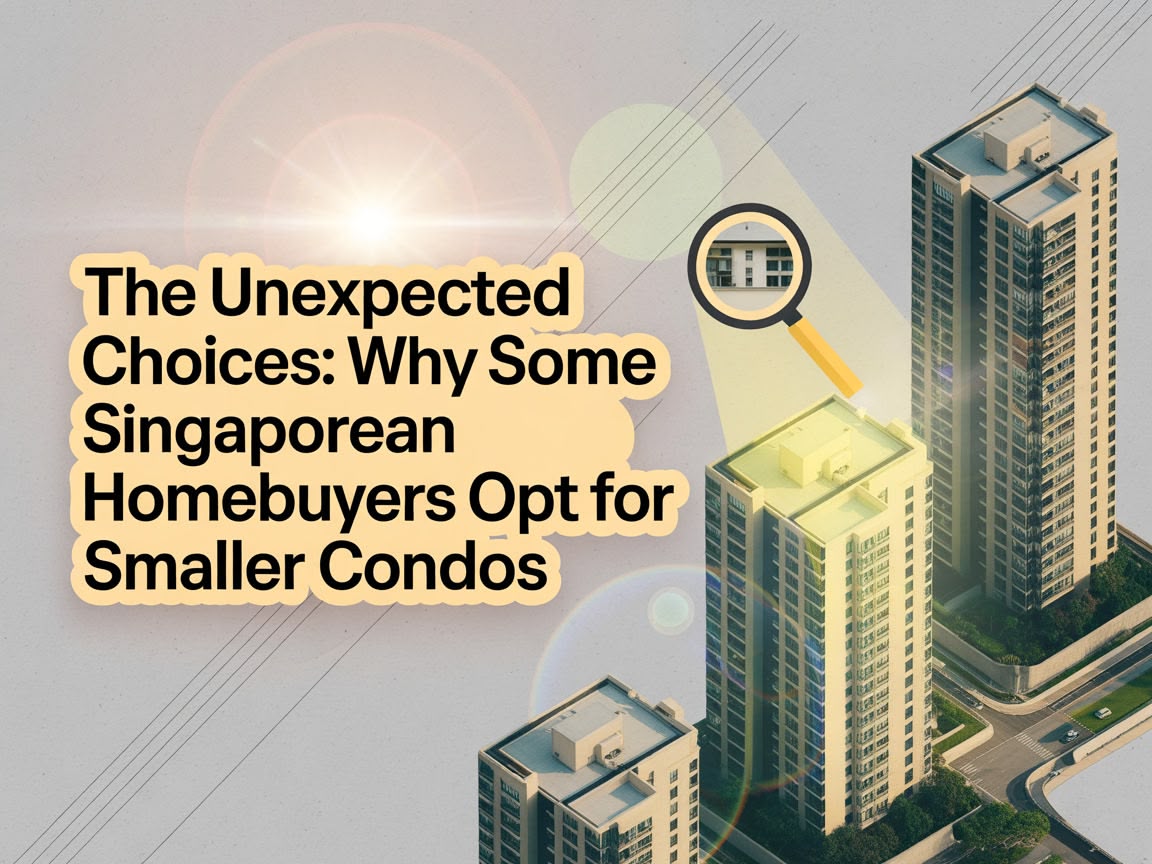
In Singapore’s property market, buyers often prioritize factors beyond just size. Many choose smaller units within their budget due to better layouts, locations close to MRT stations, or newer developments offering efficient designs and fewer renovation costs. Older homeowners may downsize strategically to better match family needs and boost retirement savings. Investors might prefer smaller units with higher rental yields and lower capital commitments for reduced risk. These choices reflect thoughtful planning rather than impulsive attempts to maximize space. The key is to focus on comfort, convenience, or financial returns instead of just square footage. Consulting real estate professionals can help align purchases with long-term goals amid tight supply and varied market conditions.
In Singapore, there’s a prevalent mindset among property buyers, whether for HDB flats or condominiums: acquire the largest possible unit within your budget. This often stems from a lingering concern that failing to maximize square footage now will result in higher costs later. However, it’s often surprising to observe that some homebuyers, despite having the financial capacity for a more spacious residence, consciously choose a more modest option. We’ve spoken with real estate professionals to shed light on these less common decisions and understand the rationale behind them.
A real estate agent recounted a recent transaction where clients faced a choice between a 1,200 sq. ft. three-bedroom unit and a 700 sq. ft. two-bedroom unit. Despite their budget clearly allowing for the larger option, the clients ultimately selected the smaller apartment. The agent explained:
“For the specific development they desired, no units larger than 700 sq. ft. were available. We explored other projects in the vicinity and found a 1,000 sq. ft. three-bedroom unit. However, after viewing it, they declined. That particular three-bedroom unit was further from the MRT station, had a less practical layout with no enclosed kitchen, felt somewhat confined, and lacked a proper service yard. Expanding their search radius was not an option they wished to pursue beyond that neighborhood. Consequently, they settled for the 700 sq. ft. unit, despite being able to afford a more sizable home elsewhere.”
Such scenarios are becoming more frequent in 2025, exacerbated by a tighter supply of resale properties. Buyers might discover an ideally situated resale project only to find that larger unit types (three-bedroom, four-bedroom, or more) are unavailable. This can lead them to purchase a smaller two-bedroom unit, saving the difference for a potential future upgrade.
Another motivation for selecting a smaller unit is a deliberate move towards right-sizing, particularly among older homebuyers whose children may soon be leaving the nest. One instance involved a couple who recently sold their landed terrace house, where they had resided with two of their adult children.
The proceeds from their landed property sale were more than sufficient for a three or four-bedroom condominium. Yet, they disregarded recommendations for larger units and actively sought a two-bedroom apartment. The agent involved shared:
“One child was planning to get married and move out within a year or two, and the other child already had their own place. A key reason for their move from the landed property was their age; maintaining a larger home had become increasingly challenging. So, they opted for a smaller unit, conveniently located within walking distance of one of their children.”
From a financial planning perspective, choosing a two-bedroom unit also allowed them to bolster their retirement savings, giving them the confidence to purchase a condominium rather than further downsizing to an HDB flat.
A real estate professional described a case where a couple chose a new launch two-bedroom unit at ELTA over a three-bedroom unit at the resale Clement Canopy. Both developments were situated in close proximity within the Clementi area, making location a non-determining factor. The significant difference lay in the price: the ELTA two-bedroom unit was approximately $1.94 million, while the Clement Canopy three-bedroom unit was around $2.18 million, a difference of about $240,000.
For this $240,000 saving, they acquired:
Furthermore, new launches typically present fewer valuation issues, as the developer’s price is generally accepted as the fair valuation. In contrast, resale properties sometimes face valuation discrepancies that may require buyers to top up with cash. Given that the couple had alternative accommodation until ELTA’s completion, the smaller, newer two-bedroom unit proved to be the more sensible choice.
An agent shared a scenario involving a couple implementing a “sell one, buy two” strategy, where they were deciding on their second investment property. Their combined sale proceeds and savings were sufficient to acquire a three-bedroom unit (approximately 1,050 sq. ft.) at DUO Residences.
However, after further viewings, they changed their minds and opted for a smaller two-bedroom unit (around 678 sq. ft.) at The M. Their reasoning was based on optimizing rental yields and minimizing capital commitment. The DUO Residences three-bedroom unit, costing about $2.1 million, had a projected gross rental yield of 3.4% to 3.7% per month (based on $6,000 to $6,500 rental income).
Conversely, The M’s two-bedroom unit, at about $1.4 million, offered a higher yield of 4.4% to 4.9% (based on $5,200 to $5,800 rental income). The reduction in living space was not a concern, as the unit was intended solely for rental income, not personal use. Beyond higher yields, the lower capital investment also translated to reduced risk, a significant advantage given their apprehension about taking on separate mortgages.
In these instances, a clear, forward-thinking strategy – rather than an impulsive decision to buy the largest available unit – ultimately served the buyers’ objectives. This underscores the importance of thoroughly discussing your intentions for a property. Instead of merely asking, “What can I afford?” it’s more beneficial to inquire, “What am I aiming to achieve by purchasing this property?”
The key is not to maximize square footage at all costs, but to maximize comfort, convenience, or financial returns. Reach out to us if you’d like to explore how these considerations apply to your specific situation and help make a well-informed long-term decision.
If you’re reading this, you must be trying to figure out the best course of action right now: is it the right time to buy or sell?
It’s difficult to give an exact answer since everyone’s situation is unique and what works for one person may not necessarily work for you.
I can bring you a wealth of on-the-ground experience and a data-driven approach to provide clarity and direction. From beginners to experienced investors, our top-down, objective approach will help you on your real estate journey.
I can help you by:


You May Also Like …

























A password will be e-mailed to you