
Discovering the Response of Private Property Owners towards the 15-Month Wait-Out Phase
TLDR The blog post discusses the impact of the 15-month wait-out period cooling measure on private property owners in Singapore....
Read More

TLDR
When considering buying a landed property in Singapore, you have options like terrace homes, semi-detached houses, and bungalows. Understanding the different types and their unique characteristics is essential before making a purchase. Prices vary significantly, with terrace homes starting around $4 million, semi-detached houses over $5 million, and bungalows around $11 million. Factors like location within Singapore can also impact pricing. Financing options include using CPF savings or getting a bank loan. Ensure you understand the rules and financial implications before proceeding. Title checks are crucial for landed property purchases to avoid legal issues or boundary disputes. Consider seeking professional advice to navigate the process smoothly.
In Singapore, purchasing an HDB flat or condo is a common experience. However, buying a landed property is less familiar territory for many of us. This is unsurprising since only a small fraction, around 5%, of Singaporean households live in such properties.
So, for those lucky enough to be considering a purchase of this sort, or simply curious about what it entails, here’s a straightforward and comprehensive guide to owning a piece of landed property in the Lion City.
In Singapore, you’ll find three primary kinds of property with their own patch of land. These include terrace homes, semi-detached houses, and bungalows.
In the words of URA, a terrace house is essentially one that owns its own plot of land and is part of a continuous row of at least three homes. These homes are unified by shared walls. The corner terrace houses, the two end ones, usually gain more interest as they often come with more land.
On the other hand, a semi-detached house is essentially one half of a pair of houses. Each with its own land title, these houses are linked by a shared wall on one side. They’re typically connected side-by-side but can also be back-to-back.
A bungalow, in contrast, is an unattached house possessing its own land title. It doesn’t share walls with any other property and is encompassed by open land.
It’s important to note that all these kinds of landed properties can possess strata titles.
A good class bungalow, also known as a GCB, isn’t just your ordinary bungalow. There are some special traits that set it apart:
Firstly, a GCB has to be within one of the 39 areas earmarked by URA for GCBs.
Secondly, its land should measure at least 1,400 square meters, which roughly equates to about 15,069 square feet.
Thirdly, it shouldn’t tower more than two floors, although an attic and basement don’t count in this rule.
Lastly, a good chunk of the land, about 60%, should be dedicated to plants, trees, and other elements of landscaping.
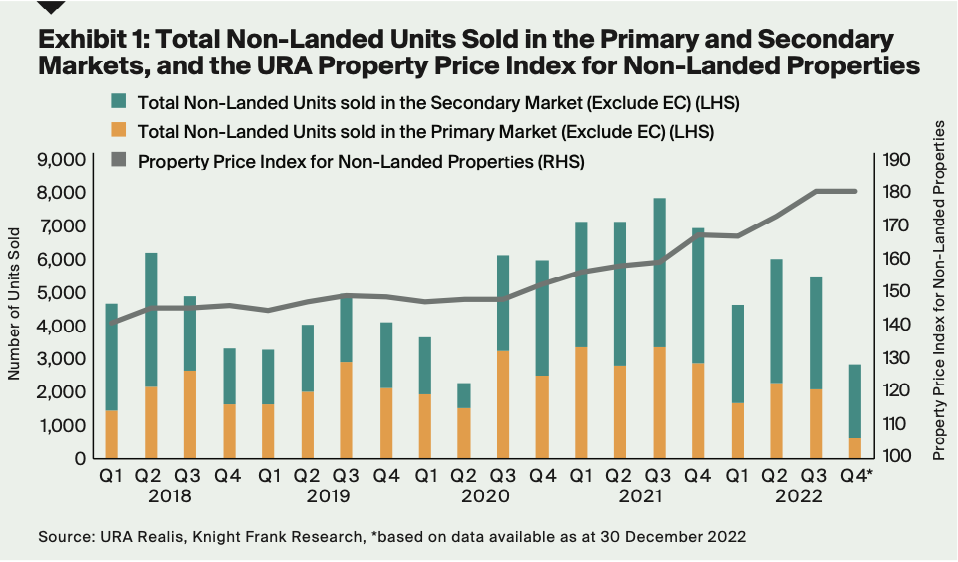
Data from URA, responsible for tracking private residential property figures, shows that the price index for landed houses stood at 231.2 in the second quarter of 2023. This was a slight rise from the first quarter’s figure of 228.7, which itself had seen a 5.9% jump from the last quarter of 2022. Interestingly, this is the highest among all private residential categories, with condos included.
From January to August 2023, more than 730 resold landed homes changed hands, as recorded by URA’s Private Residential Property Transactions. For our study, we focused on resale properties, which form the majority of landed house sales. We didn’t consider fresh sales or sub-sales, or landed properties with strata titles.
It’s important to mention that purchasing a landed house isn’t pocket change for most folks. The availability of these types of properties is rather scarce too. You’d typically have to shell out close to $4 million for a terrace home, over $5 million for a semi-detached, and around $11 million for a bungalow.
Where you choose to live definitely counts. In Singapore, if you’re looking for the most cost-effective place to purchase a house with its own land, then the Outside Central Region (OCR) is your best bet. On the flip side, if money’s no object, the Core Central Region (CCR) is known for its high-end prices. It’s also where you’ll find the Good Class Bungalows (GCBs). These aren’t just any homes – they’re owned by some of the richest people in the country.
In Singapore, buying land isn’t easy for everyone. The rules say that if you’re not from Singapore, you have to ask for permission first. This applies to people who are not Singapore citizens, companies, partnerships, or societies. Even if you live in Singapore permanently, you still have to ask.
The Singapore Land Authority (SLA) is the one who says yes or no. They look at things like how long you’ve lived in Singapore, and what you bring to the country’s economy. Even your job and how much you pay in taxes matter. But remember, even if you want to buy land in Sentosa Cove, you still need to ask SLA first.
When buying a private home or landed property, you have two financial options. You can use your CPF savings and/or get a bank loan to help you pay for it.
If you decide to use your CPF savings to buy a home, there are certain rules you need to follow. The property needs to have more than 20 years left on its lease. How much CPF you can use is based on the age of the youngest owner and the remaining years on the lease. To use the most money from your CPF, the length of the lease needs to last until the youngest owner turns 95.
The most CPF you can use to buy a private home (including landed property) depends on two things. First, the purchase price of the property or its value at the time you buy it, whichever is less. Second, whether you’ve reached the Basic Retirement Sum (BRS). If you haven’t met the BRS, you can use up to the lower of the purchase price or the valuation price. If you’ve met the BRS, you can use an extra 20% of the lower of the purchase price or the valuation price.
If you decide to get a bank loan, the rules for how much you can borrow are the same as for any private property purchase. If you don’t have any other loans, you can borrow up to 75% of the purchase price. But you also need to make a cash down payment of at least 5%. In addition, all your debts, including the housing loan, can’t be more than 60% of your monthly income before taxes.
Just like other property buyers, if you’re buying a landed property, you’ll have to pay buyer’s stamp duty, additional buyer’s stamp duty, and seller’s stamp duty.
Unlike purchasing apartments or condos, owning a house with its own piece of land adds another layer to the decision-making process.
The land your potential home sits on might come with special agreements or rules that limit how it can be used. Think of it like this: if your plot of land is the only way to get to another house, there’s a good chance that there’s an agreement in place allowing the other homeowner to use part of your land for access. This means you can’t just build anywhere on your land without considering these agreements.
Knowing the exact boundaries of your land is also super important to avoid stepping on someone else’s property or government-owned land. There was even a situation where a couple unknowingly encroached on government land for nearly 15 years!
Though most houses with their own land don’t come with such special agreements or rules, it’s a good idea to have a lawyer check everything out for you and point out any potential problems.
According to the Urban Redevelopment Authority (URA), when someone wants to buy a property in Singapore, they can file a document called a caveat. This document is registered with the Singapore Land Authority (SLA) and it shows that the buyer has a legal interest in the property. Usually, this happens after the buyer has decided to buy the property or signed a sales and purchase agreement.
Not everyone decides to file a caveat with the SLA. Because of this, some property sales might not be recorded by the URA’s Private Residential Property Transactions. These sales won’t be known to the public. But, it’s a good idea for buyers to file a caveat. It helps protect their rights. If more than one person claims to own the same property, the person who filed their caveat first is considered the rightful owner. Usually, the buyer’s lawyer will file the caveat as part of the process of transferring the property from the seller to the buyer.
If you’re reading this, you must be trying to figure out the best course of action right now: is it the right time to buy or sell?
It’s difficult to give an exact answer since everyone’s situation is unique and what works for one person may not necessarily work for you.
I can bring you a wealth of on-the-ground experience and a data-driven approach to provide clarity and direction. From beginners to experienced investors, our top-down, objective approach will help you on your real estate journey.
I can help you by:

You May Also Like …









A password will be e-mailed to you