


Could It Be Wise to Sell Your Property After Just 3 to 4 Years?
TLDR In this blog post, the writer delves into the Singapore property market, particularly focusing on the effectiveness of quick...
Read More


TLDR
The National Day Rally 2023 introduced a new classification for HDB flats, replacing the old ‘mature versus non-mature estates’ system with ‘prime, plus, and standard’ categories. Changes include longer minimum stay periods for ‘plus’ and ‘prime’ flats, impacting resale rules and eligibility criteria. The revamped system aims to discourage property speculation and prioritize genuine homeowners. The extended 10-year Minimum Occupation Period (MOP) may deter buyers initially but could stabilize prices in the long run. The new classification benefits singles, offering more options for 2-bedroom flats. The system aims to align with real-world conditions and differentiate between home-seekers and investors. Potential ripple effects include changes in resale flat prices and market dynamics. Buyers and sellers are advised to consider individual circumstances before making real estate decisions.
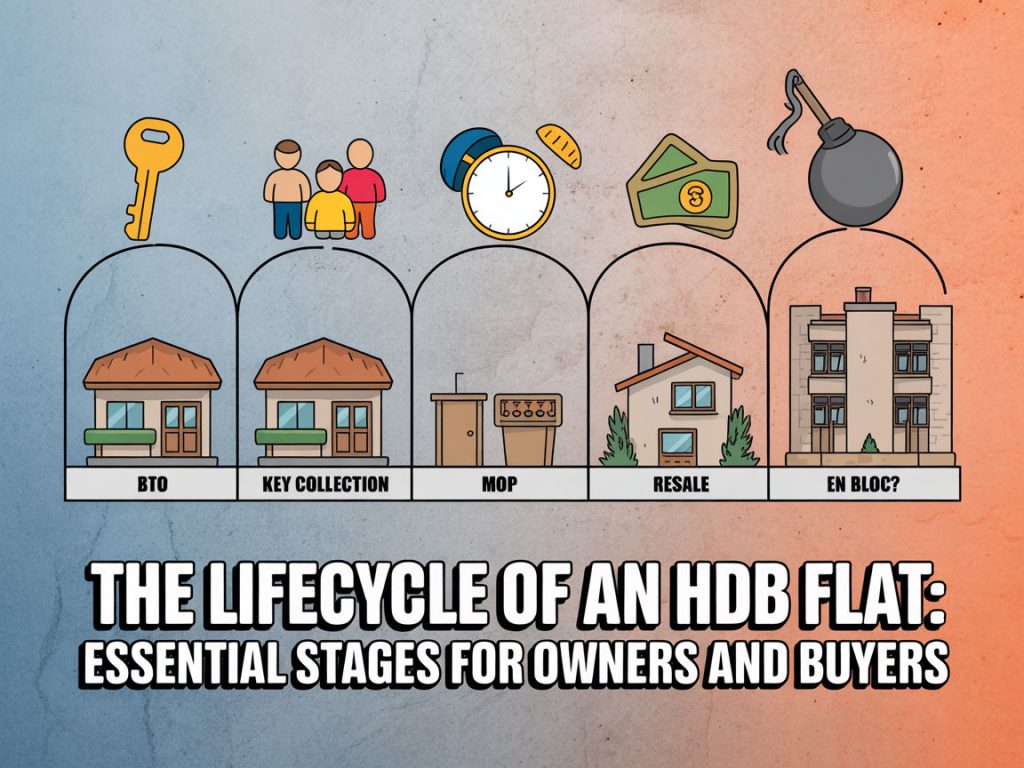
Big news, everyone! National Day Rally 2023 has unveiled a fresh way of classifying HDB flats. We’re moving from the old ‘mature versus non-mature estates’ system we’ve been using since ’92, to a new ‘prime, plus and standard’ classification.
Alongside this change come some new rules. If you’re eyeing a ‘plus’ or ‘prime’ flat, brace yourself for longer minimum stay periods. Just like with anything new in the property world, this is bound to shake things up a bit. Prices might wobble, and it could help stop people from treating HDB flats like money-making machines. We’ve been weighing up these changes and gathering people’s thoughts on the matter. So, let’s dive in and see what’s going on.
(SR costs aren’t uniform, and they fluctuate depending on the specific project. HDB will let you know the SR cost before the purchase).
The first plus-rated apartments will become visible in 2024. And yes, we’ve read your minds: the fresh rating method won’t look back, and it certainly won’t touch the flats already in existence.
Prime apartments will implement complete eligibility rules for future owners. This means next-time buyers must satisfy all conditions to purchase a Build-To-Order (BTO) apartment, like the $14,000 income limit, racial quota, and age limits, among others.
Plus apartments too will carry some BTO-like eligibility rules affecting future owners. More specifics are yet to be revealed, but it’s certain that the $14,000 income limit applies even to later resale buyers. Also, only Singaporeans can buy these Plus apartments when resold. People moving from private homes will have to wait for two and a half years before they can buy these flats on the resale market. Just like Prime apartments, Plus apartment owners cannot lease out their entire flat at any point.
No changes have been made to existing rules for Standard flats. This means there is no income limit for people buying these resold flats.
In the past, single individuals weren’t allowed to purchase 2-bedroom government-built flats in well-established regions. However, with the new changes in place, these restrictions have been lifted. Now, single folks can opt for 2-bedroom flats anywhere they wish, given they fulfill standard prerequisites. For instance, they must be at least 35 years old and their income should not exceed a certain limit.
Property experts and market researchers we consulted weren’t shocked when HDB decided to scrap certain categories. Many felt this change was inevitable.
The old system of dividing areas into mature or non-mature felt outdated even a decade ago. It was apparent that due to Singapore’s drive towards decentralization, the notion of “non-mature” areas would eventually become obsolete.
This classification system also didn’t make sense in larger HDB towns. For instance, consider Tampines. Even though it’s an established town, most commercial establishments, offices, and transport facilities are concentrated in Tampines Central. In contrast, sections of Tampines closer to IKEA bear more resemblance to emerging towns.
An unnamed top executive from a real estate firm shared that the revamped system can handle complexities that the previous model couldn’t. For instance, it wasn’t practical to include popular spots like Bishan under the old model despite high flat demand. This was mainly due to the scenario where standard flats nearby, without the same 10-year MOP or SR, would likely experience a surge in prices.
The introduction of “plus” flats serves as a bridge between high-demand areas and places truly deserving of the prestigious PLH label.
Therefore, most agree that classifying flats based on their closeness to facilities, rather than the maturity of the estate, provides a more balanced approach.
The government has certainly introduced some significant adjustments. However, when we chatted with estate agents, market researchers, and property buyers, they offered different perspectives:
The PLH model has made strides in reducing the “lottery” aspect of getting a much-coveted apartment. With the inclusion of SR and a 10-year MOP, the demand for these apartments is not as high as it could be. This ensures that those who genuinely desire to live in these locations can secure an apartment over those simply looking to make a profit.
The addition of plus apartments extends this approach to non-PLH flats, which may also present unanticipated benefits. For instance, flats near Yishun Central or Tampines Central might not meet the criteria for PLH status, but they are likely to surpass flats in other parts of those towns in terms of value.
Most property agents agree that the 10-year MOP may initially deter buyers. However, some suggest we need to observe how longer-term MOP impacts pricing to determine its effectiveness.
It will take until between 2031 to 2038 to see the first group of PLH flats (in the Rochor area) reach their MOP. At this stage, we’ll have a clearer picture of its effect on the resale market.
Interestingly, property agents speculate that buyers might lean towards resale flats close to prime or plus locations, which offer similar location benefits without restrictions.
The extended 10-year MOP (Minimum Occupancy Period) is a pretty neat way to slow down house-flipping. You know, it’s when folks buy a flat and plan to upgrade after five years. But imagine waiting for 10 years plus the construction time!
Say, if the construction takes about four to five years and then there’s the 10-year MOP, that’s almost 15 years before they can move to a bigger place. Meanwhile, private houses might get pricier and the price difference could be huge by the time they’re ready to upgrade.
But hey, if someone still chooses to buy knowing the 10-year rule, chances are they’re planning to settle down there for good or even spend their entire life in the same place.
I’ve had chats with many home buyers and guess what? They’re actually cool with this idea. They think it’s the owner-investor crowd that’s pushing up the resale flat prices. Here’s what one of them had to say:
“Look, I don’t mind if people buy flats as stepping stones. But if they do, they shouldn’t get priority over those who desperately need a home. The well-located flats should go to those who really want to live there, not to those eyeing to buy a condo later.”
Another guy had a bolder idea. He thinks the extended MOP isn’t tough enough. He suggests:
“Why not give all the best locations a 60-year lease instead? That’d surely put off investors as the resale value would drop after 30-40 years. Younger buyers would also reconsider, since they’d have to move eventually. But hey, a 60-year lease could make the price more affordable, and they’d spend less from their CPF. It would work for most middle-aged folks and our ageing population too, giving those who can’t travel much better access to facilities. To me, the 10-year MOP seems like a gimmick.”
Regardless, the new Plus model is bound to make HDB flats more budget-friendly with the longer MOP and stricter rules.
Realtors are buzzing with talk that the new housing rules might not apply to older flats in prime locations. This could make these properties even hotter commodities. As one realtor put it:
“The freshly minted luxury flats come with stringent rules and a 10-year waiting period, but the tried-and-true flats in Queenstown or Bishan? They’re free from such restrictions. This makes them more appealing and could drive up their prices, at least for now.”
A home buyer also chimed in, pointing out that the 10-year wait might mean these glossy new flats take longer to hit the resale market. They asked:
“If these swanky new flats take twice as long to hit the resale market, are we limiting the number of available resale properties in prime locations?”
From our perspective, this is something the market will adjust to over time, maybe over the next decade or two. On the flip side, trying to apply the new rules to existing flats could shake up the entire property market.
Consider the much-coveted flats in Tiong Bahru, Bishan, Queenstown, and the like. They’re among the oldest and, while they don’t have a 10-year waiting period, their steadily aging leases might keep their prices in check.
*We’re assuming the reference to ‘twice as long’ is about the waiting period, and not including construction time.
Looking at some of the chatter online, it’s clear that singles aren’t exactly jumping for joy. Sure, they appreciate having more options now, but they’re also voicing that this change doesn’t shake things up much. It might tackle a few supply problems, but the bigger issues – like being old enough and affording a place on one paycheck – haven’t disappeared.
Even now, some singles feel like they’re getting the short end of the stick.
The real sticking point for singles wasn’t just limited buying options (although that was a part of the frustration), but the age requirement of 35 years old. And yep, this is still causing a headache.
All in all, we need to move forward, mainly due to the decreasing significance of the mature/non-mature label.
The new system aligns better with real world conditions. A flat near a train station or local mall is bound to be more valuable and easier to live in, regardless of how built-up the surrounding town is. In the same vein, some sections of older towns are still hard to reach (Sunset Way in Clementi, we’re talking about you).
Looking at the big picture, this could help distinguish true home-seekers from those buying as an investment. A 10-year minimum occupation period could keep prices reasonable in popular areas – like near the train station – by eliminating competition with those buying for profit.
And what about the future? We’re keen to know how Plus flats will be categorized. Exactly how near does a flat have to be to transportation or top schools to qualify as a Plus flat?
Lastly, what impact will this have on the private property market? There might be changes as more public housing flats take longer to become available for resale, potentially stabilizing prices.
If you’re reading this, you must be trying to figure out the best course of action right now: is it the right time to buy or sell?
It’s difficult to give an exact answer since everyone’s situation is unique and what works for one person may not necessarily work for you.
I can bring you a wealth of on-the-ground experience and a data-driven approach to provide clarity and direction. From beginners to experienced investors, our top-down, objective approach will help you on your real estate journey.
I can help you by:


You May Also Like …
























A password will be e-mailed to you