
Top 5 Factors To Consider When Choosing Between A Resale Condo And A New Launch In Singapore
The decision to invest in a condominium in Singapore can be a challenging one, especially when faced with the choice...
Read More

TLDR
When comparing a large, centrally located resale flat (e.g., 5-room HDB) with a small condo around the $1 million mark, the key trade-offs are space versus facilities and investment potential. Flats offer more living space, access to grants, better local amenities, and lower monthly fees, but have stricter resale rules and limited appreciation potential. Condos provide greater flexibility for resale, fewer restrictions for buyers, potential for higher price appreciation, and access to facilities, but often come with higher maintenance fees and can be more isolated if not centrally located. There’s also the risk (or opportunity) of en-bloc sales for condos, plus freehold options not available with HDBs. For most families prioritizing space and value, flats make sense; those wanting flexibility, investment upside, or long-term legacy may prefer a condo. Your decision should match your lifestyle and financial goals.
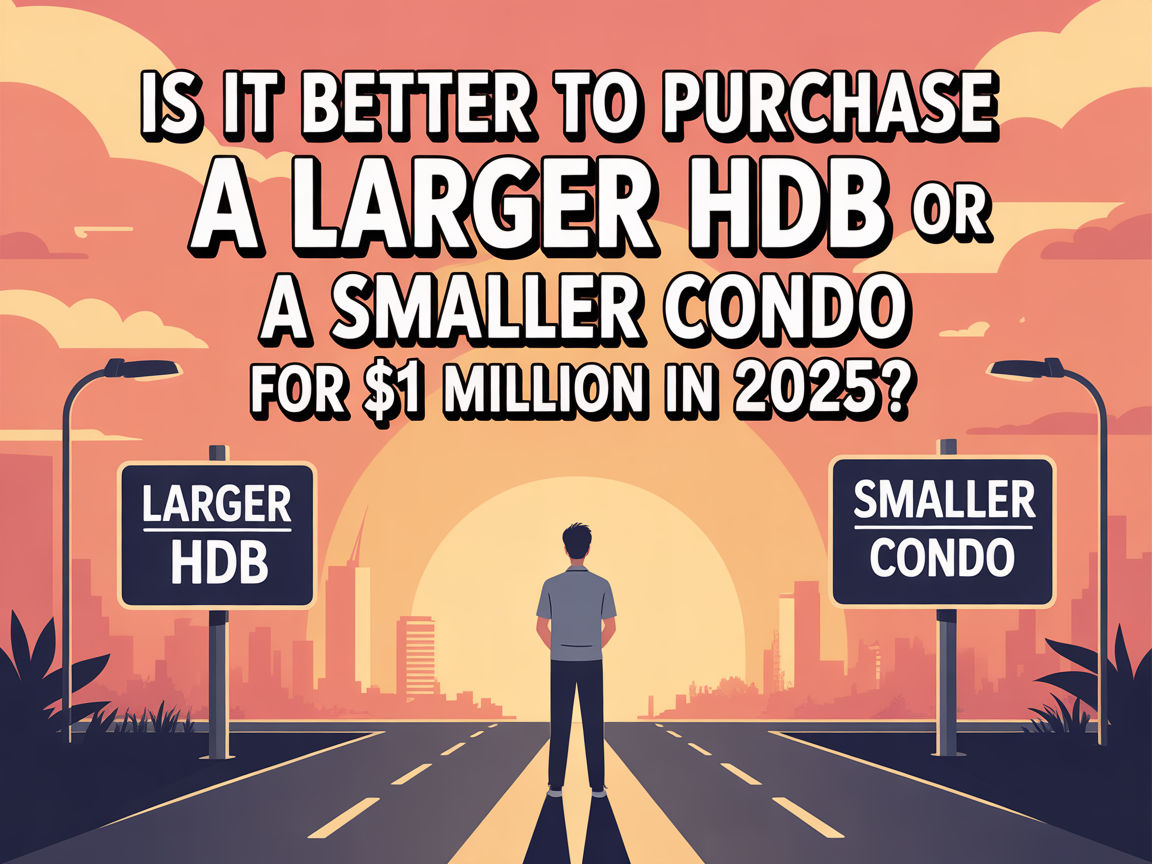
As more central area flats reach the million-dollar threshold (or at least around $800,000), it’s worth re-evaluating the appeal of smaller or more remote condo units. While it is possible to find a small resale condo priced near a million, how does that stack up against the generous space offered by a five-room or larger flat, especially one situated in a central location? Although you might not have access to a tennis court or swimming pool, being conveniently located next to an MRT station or near the CBD could compensate for that. Let’s examine the advantages and disadvantages:
It’s undeniable that the trade-offs will be significant. In addition to a smaller kitchen and absence of outdoor space, the common bedrooms are frequently quite compact as well.
From a livability standpoint, this trade-off can sometimes prove to be challenging to accept. However, if you believe you can forgo some space, here are additional factors to take into account.
The primary advantages and disadvantages of choosing a larger resale flat compared to a smaller condominium.
We will omit the most apparent factor, which is living space. If you have a large family, we can safely assume the answer is clear (please choose the larger apartment!). Otherwise, some of the other considerations would include:
When comparing a $1 million 5-room flat to a $1 million condo, another important aspect to consider is the availability of grants and subsidies. For example, married couples purchasing a 5-room flat may qualify for the $50,000 Family Grant (FG), while those living within four kilometres of their parents can access the Proximity Housing Grant (PHG) worth $20,000. Additionally, if they reside with their parents in the same larger flat, the PHG can increase to $30,000.
There is also the Enhanced Housing Grant (EHG), which is income-based; however, since buyers of million-dollar flats are likely to fall into higher income brackets, the benefit they receive might be minimal.
Thanks to these various grants and subsidies, the price difference between a million-dollar flat and a million-dollar condo may be greater than one might anticipate.
This issue is becoming less significant as more MRT stations are built annually and Singapore continues to decentralise. However, HDB flats typically benefit from superior transport infrastructure and local amenities, including coffee shops, markets, hawker centres, minimarts, and more.
When HDB develops a town – like the forthcoming Bayshore – they proactively ensure there are bus or train connections, along with facilities such as childcare centres and clinics. HDB projects are generally envisioned as part of an entire town, while developers often regard condos as more isolated projects.
(The exception to this is Executive Condominiums or ECs, which are classified as HDB properties for their initial 10 years. You might notice that many ECs are located quite a distance from MRT stations and community hubs.)
To be frank, some of the more budget-friendly condos are usually situated in less central areas. Consequently, you will find that condos outside prime locations (i.e., those likely to be priced in the low-million range) tend to be somewhat isolated: Bullion Park, Hedges Park, Parc Olympia, etc.
If you must rely on a taxi or private hire vehicle, consider that the daily commuting cost over the next few years can indirectly increase the price difference between a condo and a flat. This also applies to food and grocery deliveries: flat residents can often walk a few minutes to reach a minimart or coffee shop, whereas condo residents might need to order their supplies.
When purchasing a standard HDB flat, you are required to wait five years before you can resell it. For future Plus and Prime flats, this Minimum Occupancy Period (MOP) is increased to ten years; however, as these flats are brand new, none have reached the resale market yet.
This limitation can create issues if your children finish their education and need to attend a school that is located far away. Similarly, if you change jobs, you may find it challenging to relocate closer to your workplace until your MOP has elapsed.
In contrast, with condominiums, you enjoy significantly more flexibility and can move whenever you wish. This is one reason why some singles, even if they qualify to purchase a flat, opt for the adaptability offered by a small condominium unit. It is important to note that there is a penalty for selling within the first three years, known as Seller Stamp Duty (SSD). This tax is set at 12 per cent of the selling price in the first year, eight per cent in the second year, and four per cent in the third year – but incurring the SSD is preferable to being completely unable to sell.
Condos are often easier to sell due to fewer restrictions on buyers. Anyone can purchase a condo unit, whether they are a Singaporean, Permanent Resident, foreigner, or even a corporation (provided they are willing to pay the Additional Buyer’s Stamp Duty). In contrast, HDB flats have eligibility criteria such as ethnic quotas, age, and nationality. It’s worth noting that for future Plus and Prime flats, income ceilings will still apply even during resale.
(Standard resale flats do not have an income ceiling)
It’s important to highlight that the ethnic quota can lead to being undervalued when selling if the quota is already filled—something that does not apply to condos.
Another factor to consider is financing: an HDB flat necessitates a Mortgage Servicing Ratio (MSR) of no more than 30 per cent (meaning the buyer’s monthly loan repayment cannot exceed 30 per cent of their monthly income). This limitation does not apply to condos, where only the Total Debt Servicing Ratio (TDSR) is relevant.
The TDSR is considerably more lenient than the MSR, permitting monthly loan repayments to reach up to 55 per cent of the buyer’s monthly income (after deducting other existing loans).
Although there are exceptions and outcomes can differ depending on the area, private properties typically appreciate in value more effectively than resale flats.
Take, for example, the price trends of resale Executive Maisonettes (EM) and jumbo flats over an approximate ten-year span (we focus on these types of flats as they are more likely to attain the million-dollar threshold):
Prices increased from $434 per square foot to $559 per square foot, representing approximately a 2.56 per cent annualised return.
In contrast, resale condominiums saw prices rise from $1,210 per square foot to $1,680 per square foot over a decade, yielding about a 3.36 per cent annual return.
Once again, this provides a very broad overview across the island, and there may be exceptions for specific towns and properties; however, generally speaking, we’ve observed greater appreciation in private units compared to HDB flats. This distinction is perhaps expected, as HDB flats are intended for residential use rather than as an investment; this is a factor worth considering when making your choice.
Condos generally have maintenance fees ranging from £300 to £400 per month. This amount covers a variety of expenses, primarily the maintenance of amenities like pools, tennis courts, and BBQ areas. These fees are significantly higher than the conservancy charges imposed by town councils, with even the largest flats rarely exceeding £100 per month.
In addition to considering these costs, it’s important to reflect on whether the amenities are valuable to you. If you don’t swim, use the gym, or play tennis, is it really worth it to pay such high fees? Similarly, is having 24-hour security essential for you?
If your main priority is a large, spacious unit, then opting for a flat might be a more practical choice. Alternatively, you could look into apartments that lack facilities, such as walk-up units or those located above commercial establishments. These options typically come with lower maintenance fees.
HDB flats do not undergo en bloc sale to private developers. Currently, the only methods for them to be sold en bloc are SERS (which affects approximately four to five per cent of flats) and VERS (which has yet to be observed). In contrast, condominiums allow for collective sales pushed either by private developers or the owners themselves.
The potential for an en-bloc sale can be viewed as either a blessing or a curse, depending on your circumstances. On one hand, en-bloc sales present a profitable exit strategy for condominiums, which is not available for HDB flats. This usually occurs when condos reach an age of about 19 to 24 years.
Conversely, an en-bloc sale could happen to your condominium even against your wishes. A common scenario is purchasing an older resale condominium and then encountering an en-bloc sale within the first three years. In this case, you would still be responsible for paying SSD, and after accounting for renovations and other expenses, you might find yourself barely breaking even, along with the inconvenience of having to relocate again.
If your intention is to remain in one place permanently and settle down for life, you might want to reduce the likelihood of a collective sale; therefore, opting for a flat could be preferable. However, if you are concerned about lease decay but find yourself needing to purchase an older unit, a condo’s collective sale might provide you with a beneficial “exit” in the future.
A freehold flat does not exist. Therefore, if you believe that HDB flats represent a 99-year time bomb, you might want to consider private freehold alternatives.
The challenge is that freehold condominium units generally come at a significantly higher price (approximately 15 to 20 per cent more than their leasehold equivalents), which means you may struggle to find many options around the $1 million mark. Typically, these will be older freehold condos or those situated in less desirable locations.
Nevertheless, individuals seeking a lasting asset often prefer a freehold condo. For legacy planning, it’s important to remember that no one can own two HDB flats; thus, your children or grandchildren can likely inherit your condo, but not your flat.
Today, very few individuals can afford to own several homes due to the increased Additional Buyer’s Stamp Duty (ABSD). However, if you’re determined to give it a go, consider the following:
If you begin with a flat and wait out the Minimum Occupation Period (MOP), you can opt to keep the flat when you later purchase a private property. You will need to pay the ABSD for the private property, but this approach allows you to own both.
You cannot reverse this process: if you purchase a private property, you cannot subsequently acquire a flat. In fact, you are prohibited from buying a resale flat for 15 months after selling the private property (unless you are 55 or older and are downgrading to a four-room flat or smaller).
Thus, for those looking to own two properties, it may be more advantageous to start with a larger flat instead of a small condominium.
For additional insights into the Singapore property market, along with reviews of new and resale properties, follow us. If you wish to arrange a more detailed consultation, feel free to reach out here.
If you’re reading this, you must be trying to figure out the best course of action right now: is it the right time to buy or sell?
It’s difficult to give an exact answer since everyone’s situation is unique and what works for one person may not necessarily work for you.
I can bring you a wealth of on-the-ground experience and a data-driven approach to provide clarity and direction. From beginners to experienced investors, our top-down, objective approach will help you on your real estate journey.
I can help you by:


You May Also Like …