

Sell High Buy High : Will This Still Make You a Profit?
TL;DR Summary: Timing of Property Sale: Selling high and buying high may seem counterintuitive, but understanding market dynamics can...
Read More


The Singaporean government possesses considerable authority to reclaim land, whether freehold or not, in accordance with the Land Acquisition Act. Thankfully, this authority has been exercised infrequently since the 1960s, a period during which it was essential for constructing mass housing and restructuring the city. However, this does not imply that it has been entirely unused; in fact, some private property owners have been taken aback by its application even in more recent times. Here’s an overview:
This legislation permits the government to reclaim privately owned land for developments that serve the public interest. Although its usage has been limited in recent years, there was a time between 1959 and 1984 when the act facilitated the recovery of approximately 177 square kilometers of land, which represented roughly one-third of Singapore at that period.
There are only three straightforward criteria:
5 (1) Whenever any particular land is needed –
This topic is not without its debates. You will encounter individuals who will passionately express their views on the acquisition of residential land for the purpose of selling it to private developers, questioning whether this action truly serves the “public utility” or is genuinely “in the public interest.”
(However, that is merely their perspective, and the government is legally permitted to proceed with such actions.)
This is a prevalent concern among landowners. What if your property is seized, leading to significant losses due to inadequate compensation? Let’s explore the origins of these anxieties:
Historically, compensation for land appropriated by the government did not reflect its value at the time of acquisition. For instance, in 1987, the compensation rates for land were based on their values from 1973. For properties acquired between 1987 and 1993, the values were aligned with those from 1986, and so on. This often resulted in financial losses since land values typically appreciate over time, which likely contributed to the longstanding grievances about how the government “acquires land at low prices.”
However, improvements have been implemented. On February 12, 2007, the legislation was revised to ensure that current values (i.e., those at the actual time of acquisition) are taken into account. Consequently, property owners since that date have benefited from much fairer compensation if their land is expropriated, in contrast to the experiences of previous generations.
Recent instances of land acquisition and the associated challenges include:
In June 2003, Chuan Park, a leasehold condominium completed in 1985, lost 220 square meters of land to accommodate the Circle Line. This area included approximately 17 parking spaces, and residents were quite frustrated when they learned that the compensation amount was just $1.
However, it was contended that this land acquisition would bring the Lorong Chuan MRT station much closer to Chuan Park, and that the anticipated increase in property values from the loss of those 17 parking lots made the decision relatively equitable.
While this reasoning may seem logical on paper, there are still ongoing debates about it today. Such situations can lead to misunderstandings, which often contribute to the spread of rumors regarding the government “taking properties” for little cost.
This is referenced in the same link above. In this case, a church lost part of its parking lot for just $1. The reason for this was a planning error that designated the area as a “road.”
(If the area is classified as a road, it’s not surprising that the owner received only $1, since the land cannot be utilized for anything else.)
Ultimately, it was a case of mislabeling, and the government later offered $64,000 in compensation once the situation was clarified. However, before this resolution, rumors circulated again about the government acquiring land for just $1.
(The residents of Chuan Park, who received $1 for their 17 parking spaces, likely had their own opinions on the matter!)
In 2016, the Thomson-East Coast Line (TEL) construction led to the acquisition of 15 properties in the Katong Area. This included six semi-detached homes and nine walk-up apartments, amounting to a total compensation of $45 million.
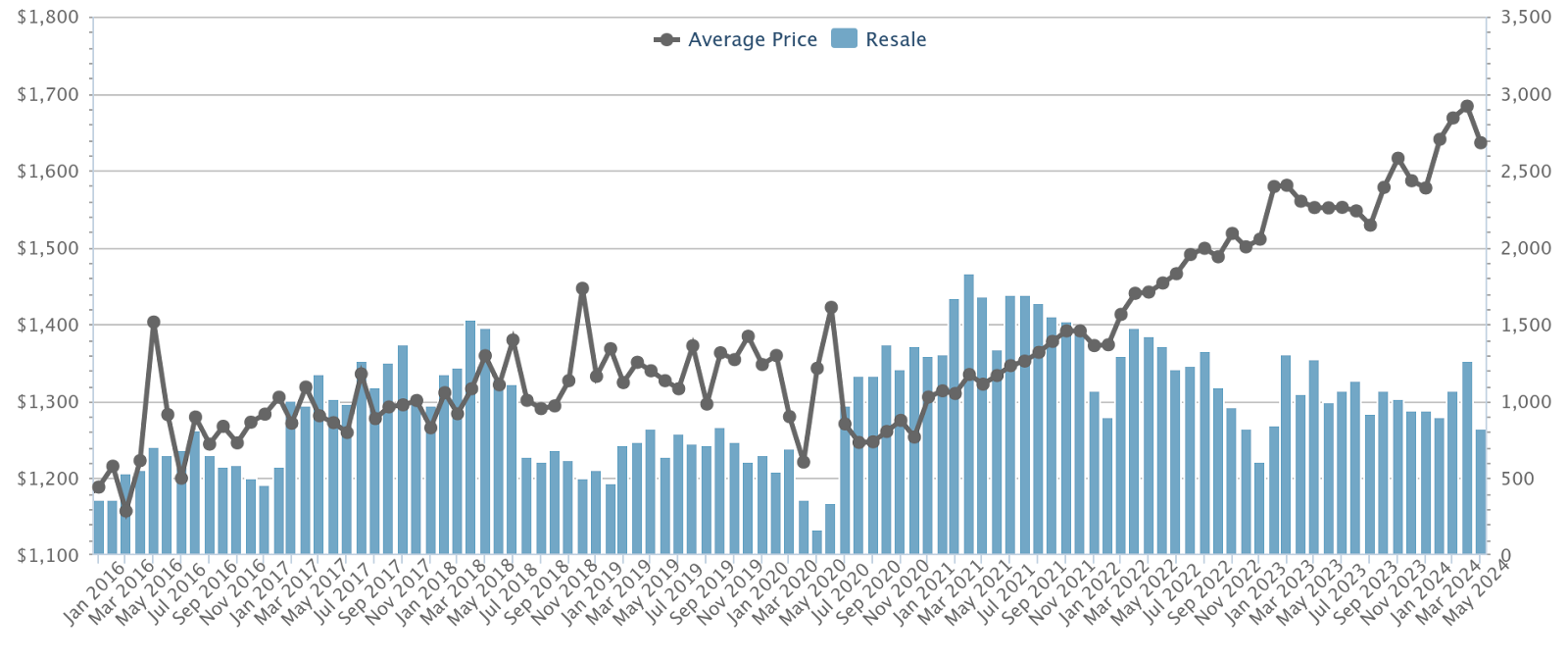
This resulted in an average compensation of approximately $1,270 per square foot. Some homeowners contested this amount, with one individual asserting that a fair valuation would range from $1,300 to $1,600 per square foot. Out of curiosity, we looked into this claim and found it to be incorrect.
Source: Square Foot Research
The average for 2016 was $1,189 to $1,273 psf for 2016, which last appreciated to $1,636 psf in May this year. So it was actually an average deal for the residents after you tack on the inconveniences of having to move.
This building, which was freehold, was finished in 1964. Engineers determined that it was too hazardous to keep occupied because earthworks for the North South Corridor (NSC) posed a threat to its structural stability.
Details regarding compensation for this case remain unclear, though some owners felt they received inadequate compensation. Nevertheless, this incident served as a crucial reminder that owning a freehold property does not guarantee protection against land acquisition. It raises concerns about the risks associated with owning a highly central property—such as a freehold in a major neighborhood hub—especially when new road and rail connections are planned.
Additionally, many people might not anticipate that land acquisition would replace what is likely a more lucrative en-bloc sale.
In 2015, the State Lands Act underwent amendments, granting you ownership of the land beneath your home up to a depth of 30 meters; anything beyond that depth falls under government jurisdiction. The amendment also enables the government to assert claims over airspace and subterranean space without needing to first claim the surface land, although this largely doesn’t impact homeowners directly.
So, what has sparked this newfound interest in claiming the land beneath residential properties? The answer seems to lie in the concept of underground cities. Rather than solely expanding upward, Singapore may look to develop downwards as well, concealing roads and other infrastructure below ground level. This approach could potentially alleviate our traffic issues by relocating roads underground, freeing the surface primarily for pedestrian use.
As of now, the implications of these changes remain to be seen, and it will likely be some time before they materialize. When the time comes, it will be interesting to observe how Singaporeans respond to the prospect of highways, train lines, and other constructions being built beneath their homes.
If you’re reading this, you must be trying to figure out the best course of action right now: is it the right time to buy or sell?
It’s difficult to give an exact answer since everyone’s situation is unique and what works for one person may not necessarily work for you.
I can bring you a wealth of on-the-ground experience and a data-driven approach to provide clarity and direction. From beginners to experienced investors, our top-down, objective approach will help you on your real estate journey.
I can help you by:


You May Also Like …