

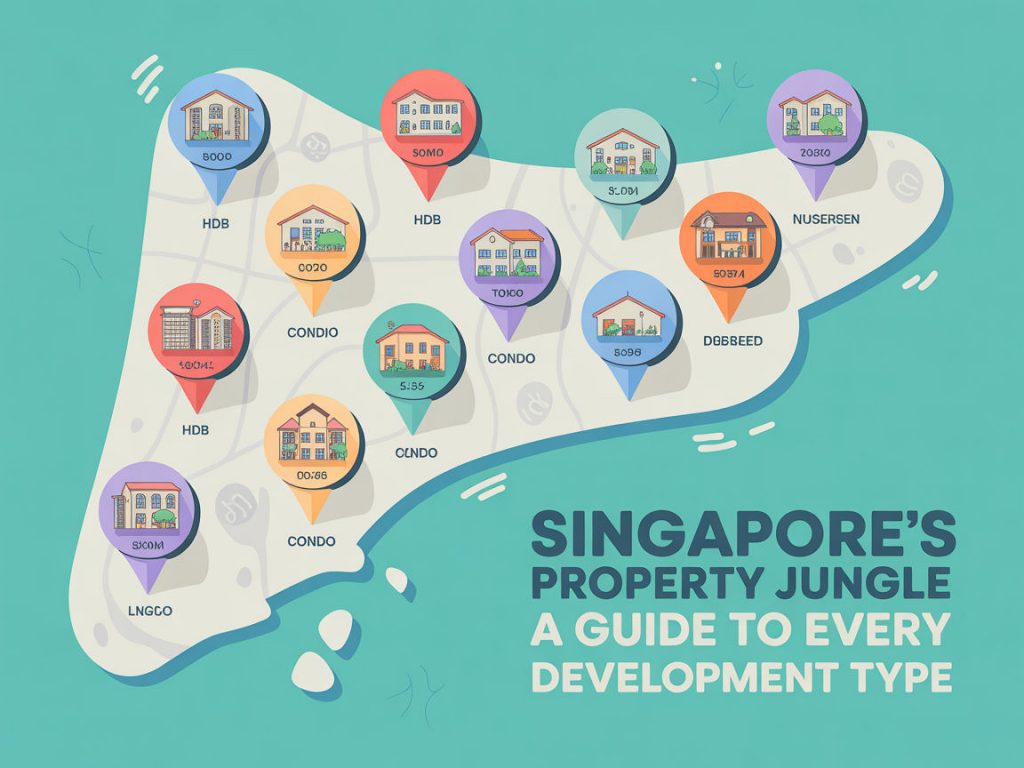
Singapore’s Property Jungle: A Guide to Every Development Type
TLDR Singapore’s real estate market features a diverse mix of property types—public HDB flats, executive condominiums, private condos, landed homes...
Read More


TLDR
When selling your first home, be aware of CPF accrued interest, which is the interest that would have accumulated on your CPF savings if you hadn’t used them for your home. This interest must be repaid upon selling your home if CPF funds were used. Calculating this interest is straightforward through the CPF Online Services portal. To minimize the impact of CPF accrued interest, consider using cash for payments, making partial repayments to CPF, and seeking professional advice. Case studies show various scenarios, including selling before and after age 55, divorce, and buying a second property. Each scenario has unique implications for accrued interest and financial planning.
When considering selling your first home, the thought of CPF accrued interest may cross your mind. For many first-time sellers, the realization that their net profits may not match the initial financing amount due to CPF accrued interest can be disheartening.
But fear not, if you decide to hold on to your home, the accrued interest does not need to be paid back. It only becomes a concern if you choose to sell and use your CPF funds. However, you do have the option to top up your CPF if you want to mitigate the impact.
To help you understand the potential scenarios and implications of CPF accrued interest on your earnings, we have compiled this article. It will also address common questions like “When does CPF accrued interest stop?” and “Should I pay back CPF accrued interest?” So, if you’re ready to part ways with your property, let’s dive in and uncover the facts.
The concept of accrued interest may seem complex, but it’s actually quite simple. It’s the interest that would have accumulated on your CPF savings if you hadn’t used them to finance your dream home. And let’s face it, who wouldn’t want to make the most of their hard-earned money?
But here’s the catch – when you finally decide to sell your first home, the accrued interest must be repaid. Don’t fret, it’s just a way for CPF to ensure that you’re saving enough for your golden years. And when that time comes, your funds will be released and you can bask in the glory of your well-deserved retirement.
So, if you’re pondering “When will my CPF accrued interest come to an end?” the answer is simple – when you bid farewell to your beloved abode. But don’t worry, it’s all part of the plan to secure your financial future.
Imagine this: You’ve been diligently saving in your CPF Ordinary Account (OA) and the accrued interest has been slowly building up over time. But then life happens and you need to withdraw $100,000 and sell your flat after the Minimum Occupation Period (MOP) of five years. That’s when you realize that the accrued interest, which is essentially the interest you would have earned if the funds had stayed in your CPF OA, is calculated at a tempting rate of 2.5% per annum.
But don’t get too excited just yet, because you’ll need to pay back a total of $12,500 in accrued interest to CPF. Yes, that’s right, a whopping $112,500 in total. But don’t worry, you don’t have to do the math yourself. Just hop on over to your trusty my CPF Online Services portal and find the accrued interest under ‘My Statement’. Easy peasy, right?
According to the regulations of CPF, if you withdraw your savings for the purpose of purchasing property, it must be returned to replenish your Retirement Account. This special account was established with the intention of providing a steady monthly income for your living expenses during your golden years. However, if you opt not to sell your property, you will not be required to refund the accumulated CPF interest.
Therefore, the answer to the question “Should I repay CPF accrued interest?” is a resounding yes. In order to further illustrate when CPF accrued interest ceases and what happens in different scenarios, let us take a look at the story of Mr. and Mrs. Lim.
At the age of 35, this dynamic duo embarked on the journey of homeownership and purchased a BTO flat for the first time. Join us as we delve into the world of HDB accrued interest and discover the amount that Mr. and Mrs. Lim will have to bear if they decide to sell their property in various situations.
Mr. and Mrs. Lim, a young and ambitious couple, utilized their hard-earned CPF savings to finance their dream of owning a home. With unwavering determination, they diligently paid off the monthly down payments for their humble abode. Despite being below the age of 55, the duo made the bold decision to upgrade to a larger property and sell their beloved BTO flat.
However, upon seeking professional advice, they were met with a harsh reality – the profits from the sale of their first property would not be enough to cover the principal amount used from their CPF (down payment + HDB accrued interest). In other words, their efforts would yield no financial gain.
As they pondered over this unexpected turn of events, the Lims realized that the involvement of HDB accrued interest would inevitably reduce their expected cash earnings from the sale. In hindsight, had they opted for a split loan with cash and CPF payouts, the accrued interest would have been significantly lower, potentially leaving them with a surplus from the sale of their flat.
The Lims, who had solely used their CPF Ordinary Account savings to purchase their first home, would now have to bear the burden of the accrued interest being added to their home loan for their next property. However, had they diversified their loan with both cash and CPF payouts, they could have potentially retained some earnings.
To add to the complexity of the situation, the couple had to also consider the possibility of selling their flat at a lower price than the amount to be refunded. Thankfully, according to regulations, they would not be required to refund the shortfall as long as the property was sold at or above market value.
One important thing for the Lims to keep in mind, however, was the need to refund any option money received from the buyer in cash. This includes the option fee or exercise fee and is considered part of the selling price. Hence, it must be refunded to their CPF account before the transaction can be completed.
In conclusion, Mr. and Mrs. Lim’s journey of using their CPF to fund their first home and subsequent upgrade serves as a cautionary tale for all aspiring homeowners. It highlights the importance of careful planning and considering various options to optimize their financial gains in the long run.
After much contemplation, Mr. and Mrs. Lim made the wise decision to hold onto their humble flat, despite the meager profits it would bring if they were to sell it. During this time, Mr. Lim ambitiously pursued a Law degree and now holds a prestigious Partner position at a well-respected Law Firm, causing his earnings to double.
However, as they approached the age of 55, the Lims couldn’t help but feel the desire to upgrade to their dream home. But with age comes responsibility, and they were reminded that they must have a minimum Basic Retirement Sum in their CPF. This amount increases each year to account for inflation and the rising cost of living. If their CPF Retirement Fund falls short of the Basic Retirement Sum (currently set at $102,900 for those turning 55 in 2024), the earnings from their first home will automatically be deposited into their Retirement Account.
Despite still being employed, the Lims were faced with the dilemma of using their CPF to finance their next property, knowing that they wouldn’t receive any cash from the sale of their first home. These common pitfalls of relying on CPF for property payments often catch first-time homeowners off guard, potentially hindering their financial goals.
Luckily, Mr. and Mrs. Lim’s increased earnings put them in a favorable position, exempting them from the Basic Retirement Sum rule. With this added income, they were able to refinance their home to a shorter tenure, despite having to pay back a significant amount in accrued interest. But with their financial stability, they were able to comfortably make the necessary payments and embark on their next chapter in their dream home.
Mr. and Mrs. Lim’s once blissful marriage has come to an end, as they have made the heart-wrenching decision to divorce and part ways with their beloved family home. Despite equally contributing to the purchase of their home, their inability to reach a fair distribution of their assets has left them at a standstill, anxiously awaiting the court’s ruling.
Complicating matters is the Women’s Charter, which could result in an unequal distribution of the flat’s returns to the estranged couple. The court will carefully consider various factors such as each party’s financial contributions, the presence of children, and the length of their marriage, potentially leading to a lopsided division of the home’s earnings, say 60-40 rather than the expected 50-50.
This discrepancy also extends to their Central Provident Fund (CPF) refunds, with the accrued interest being unevenly split between them, adding salt to the wounds of their shattered union.
Meet Mr. and Mrs. Lim, proud parents of their son Theodore, a young and ambitious 26-year-old. Unfortunately, due to their recent divorce, Theodore finds himself in the midst of buying his own property. With determination in his eyes, he ponders over how he can finance and afford his dream home.
As he contemplates his options, the question of how much CPF he should utilize for his down payment arises. After all, if he plans to hold onto his property forever, does it really matter where the initial funds come from?
However, being a wise thinker, Theodore considers the possibility of selling his home in the future. In such a scenario, he must take into account the interest that his CPF funds could potentially earn (up to 5% per annum in his Special Account). Is it worth sacrificing this opportunity cost to pay for his home upfront? What if he sells his property at a lower price, only to realize that he must pay out of pocket to cover the accrued interest on his CPF funds?
With these questions in mind, Theodore comes up with a clever solution. He decides to split his monthly payments between cash and CPF, gradually paying off his mortgage while also reducing the HDB accrued interest that he will eventually have to pay when he sells his property. A smart move indeed, for someone who knows how to make the most of their finances.
This commonly occurring situation is often met with a positive reception, as the majority believe that making a profit from their initial home when transitioning to a private residence or larger HDB apartment is a wise move. It is seen as an effective method of evading the dreaded HDB accrued interest. Nevertheless, there are two main hurdles to overcome when acquiring a secondary property while holding onto the first.
Purchasing a second property in Singapore can greatly impact your financial planning, thanks to the steep ABSD rates of 20% for Singaporeans and 30% for PRs. These rates have the power to significantly affect your net earnings, which in turn can throw your Total Debt Servicing Ratio (TDSR) off balance and result in higher monthly payments for your new home loan. Don’t let this added expense catch you off guard – be sure to factor it into your strategic financial planning.
Imagine holding onto your rental flat in hopes of generating steady income. At first, things seem promising, but as time passes, the harsh reality of property investments sets in. Your once thriving HDB flat now suffers from neglect, leading to a decrease in value. Location and other unforeseen circumstances make it difficult to find tenants. After 35 long years, you finally decide to part ways and sell.
But just when you thought you were in for a hefty profit, you are hit with a devastating blow. The compounded CPF accrued interest over the years threatens to swallow up all your earnings from the sale. Despite the rental income, the overwhelming HDB accrued interest leaves you questioning if this investment was truly worth it.
Take control of your HDB accrued interest and alleviate its weight by proactively repaying and supplementing your CPF contributions. Delaying repayment only increases your future burden. Yet, carefully consider the immediate benefits of having liquid funds and strike a harmonious balance with your capacity to reinvest at the opportune moment.
Why not consider using cash as your first choice of payment if you find yourself financially flush at the time of purchase? Not only will this spare you the hassle of computing your CPF and fretting over accrued interest down the line, but it could also have a positive impact on your long-term savings.
Why struggle to unravel the complexities of CPF when I can guide you towards the perfect solution for your savings and home value? Discover affordable mortgage options that don’t solely rely on CPF and let me assist you in making the most of your property sale.
Don’t leave it to chance, with careful planning you can turn your first sale into a triumphant success and reap the rewards when you bid farewell to your beloved home.
If you’re reading this, you must be trying to figure out the best course of action right now: is it the right time to buy or sell?
It’s difficult to give an exact answer since everyone’s situation is unique and what works for one person may not necessarily work for you.
I can bring you a wealth of on-the-ground experience and a data-driven approach to provide clarity and direction. From beginners to experienced investors, our top-down, objective approach will help you on your real estate journey.
I can help you by:


You May Also Like …
















A password will be e-mailed to you