TLDR
Decoupling property ownership in Singapore can help you avoid hefty Additional Buyer’s Stamp Duty fees when purchasing a second property. This process involves transferring ownership between co-owners, allowing one to be considered a first-time buyer. Different rules apply to HDB flat owners compared to private property owners. Decoupling can be done through sale or gift transfer methods, each with its own implications and considerations. Consulting with a qualified real estate agent is recommended to understand the costs and risks involved.
For those wishing to become property owners in Singapore, purchasing a second property may be a dream come true – but comes with a hefty price tag in the form of the Additional Buyer’s Stamp Duty (ABSD).
Singapore Citizens are charged 17%, Singapore Permanent Residents 25%, and foreigners 60%, all based on the higher of the purchase price or the current market value.
All of this, part of the government’s effort to ensure the housing market remains within bounds, together with the Seller Stamp Duty (SSD) and Total Debt Servicing Ratio (TDSR), serves to create a more balanced real estate market.
Despite the ABSD, many married couples in Singapore have managed to find a way around it and buy a second home – they call it ‘decoupling’.
What Is Decoupling?
When joint homeowners “decouple,” one co-owner can relinquish their ownership completely, allowing them to be considered a first-time property buyer and thereby purchase a second property without having to pay Additional Buyer’s Stamp Duty.
If you choose to purchase a second property worth $1 million for investment without decoupling, you will be hit with an ABSD of at least $170,000 (assuming you’re a citizen buying a second property).
But by decoupling, you can preserve that amount for other home expenses such as renovations or furnishings!
It’s important to remember that this calculation only covers the cost of the Additional Buyer’s Stamp Duty and does not take into account other potential expenses, such as existing mortgage balances and Central Provident Fund (CPF) withdrawals. For further details on decoupling, please refer to the end of this article.
It may sound appealing, but sadly, it’s not suitable for everyone.
HDB Owners : Decoupling Is Not Allowed
Since 2016, HDB flat owners have been unable to transfer their ownership to a family member, while decoupling is typically only available for private properties.
How Can Private Homeowners Decouple Their Property?
Private homeowners have two options for decoupling – they can either opt for a sale (partial purchase) or make a transfer as a gift.
Transfer By Way Of Sale (Part Purchase)
The buyer must pay the seller for the rights to the property, as outlined in the Sale and Purchase agreement, and submit the Buyer’s Stamp Duty to the Inland Revenue Authority of Singapore to finalize the process of legally acquiring all the remaining shares of the property from the spouse.
All terms of the transaction must be clearly stated in the S&P agreement, typically drawn up by a lawyer or conveyancer.
Buyer Stamp Duty (BSD) with effect from (wef) 15 February 2023
As announced during Budget 2023, the BSD rates for residential and non-residential properties are to be raised as of 15 February 2023. However, there’s a transitional BSD remission for properties acquired from that same date, allowing the former BSD rates to apply if certain conditions are met.
Homes valued between $1.5 million and $3 million will now experience a 1% tax hike as the BSD rate is increased to 5%. Those with a value greater than $3 million will be taxed at 6%.
Seller Stamp Duty (SSD) wef. 11 Mar 2017
Once the lawyer has the proceeds, they can pay off the seller’s mortgages, CPF contributions, and any SSD payments. Once that is completed, the ownership is then transferred to the buyer. Should you need any help with this, don’t hesitate to reach out to me – just give me a WhatsApp and I’ll be here to provide advice and assistance!
Scenario A: Joint ownership (50-50) by John and Amanda
John and Amanda, two Singaporeans, have been joint owners of a condominium unit with equal shares for over four years – forming a joint-tenancy, thus giving them each a 50% share in the property.
When couples purchase property together, they typically divide it equally. However, if one of the co-owners dies, the other inherits the entire asset regardless of any will.
If John earns a reliable and high income, he can take out a larger loan to purchase a piece of real estate for his family; however, the Additional Buyer’s Stamp Duty would make this an expensive endeavor.
How John and Amada can decouple the condo:
Current condo valuation: $1m
Existing home loan balance: $500,000 (split equally between John and Amanda since each of them owns 50% of the property)
50-50% part share selling price (Since both John and Amanda owns 50% shares each in the property): $500,000 ($1m/2)
John will be receiving $100,000 in cash proceeds after decoupling, which he can use to purchase a home that’s ABSD-free.
Unfortunately, this means Amanda will have to shoulder a much higher loan amount of $600,000. This may be too much for a single income to support and isn’t suitable for everyone.
That’s why we highly advise you to consult me before decoupling, so I can help you come up with a suitable financial plan, in partnership with my mortgage providers, to reach your property aspirations without draining your wallet.
Nevertheless, not all assets are shared in joint-tenancy or in equal parts as exemplified earlier.
Scenario B: Tenancy-in-common (99-1) ownership
John and Amanda have become tenants-in-common in this fresh scenario. This means that instead of a 50-50% split, John holds just 1% of the property, while Amanda has the lion’s share of 99%.
John can now move forward with his purchase of a new property without having to pay Additional Buyer’s Stamp Duty, since he has transferred the ownership of his property to Amanda.
Thanks to the 99-1 rule, the Buyer’s Stamp Duty fee is only $100, which is significantly lower than the $9,600 Buyer’s Stamp Duty he would have had to pay in the initial scenario.
The legal fees, however, remain the same. A potential challenge may arise if the couple divorces and one party ends up owning 99% of the house – this could lead to costly and lengthy court proceedings.
2. Transfer As A Gift
You can give away your portion of a property without compensation, but only if there are no remaining mortgage loans or CPF funds connected to the home’s purchase.
As of 9 May, 2022, new regulations concerning the transfer of residential properties into a living trust will come into effect.
Under the new regulations, a whopping 35% Additional Buyer’s Stamp Duty (ABSD) must be paid upfront whenever a residential property is transferred into a living trust – even if there’s no identifiable beneficiary at the time of the transfer. Goodbye loophole, hello ABSD (Trust)!
Is Decoupling For You?
If you are considering decoupling your property with your spouse, it is always wise to discuss the costs and risks with a qualified real estate agent.
Some couples may decide to pay the ABSD and proceed, while others may hesitate. Wherever you stand, obtaining the counsel of property and mortgage specialists is recommended. If you have any home loan questions, I am available to assist.
Frequently Asked Questions About Decoupling
1) What happens if I do not have sufficient CPF for the downpayment, stamp duty or legal fee?
All payable costs/fees would be paid in cash if you have insufficient CPF savings.
2) Can I get a mortgage loan for my second property?
Take into account the Total Debt Servicing Ratio (TDSR)! This rule limits your monthly loan payments to no more than 60% of your monthly income. Since various factors, such as income, employment, and credit standing, could lead to different loan amounts, talk to your bank’s mortgage officer to determine your eligibility.
3) As the seller, can I keep the sales proceeds as cash after decoupling?
The CPF Board must be the first recipient of all funds and accrued interest from the CPF Ordinary Account which are used for the payment of the property. The owner will then receive any surplus as cash.
Should You Buy, Sell or Wait?
If you’re reading this, you must be trying to figure out the best course of action right now: is it the right time to buy or sell?
It’s difficult to give an exact answer since everyone’s situation is unique and what works for one person may not necessarily work for you.
I can bring you a wealth of on-the-ground experience and a data-driven approach to provide clarity and direction. From beginners to experienced investors, our top-down, objective approach will help you on your real estate journey.
I can help you by:
- Offering Strategic Real Estate Advice – I can help create a comprehensive plan to guide you through your property journey.
- Connecting Your Home with the Perfect Buyers – Through stunning visuals, an effective communication strategy, and an in-depth knowledge of the market, we’ll ensure your home is presented in the best possible way to fulfill your goals.


You May Also Like …
Jayson Ang – March 30, 2026 – Share
TLDR Spending $1 million on a 50-year-old HDB flat in Singapore can be a rational choice for older buyers prioritizing...
Read More
Jayson Ang – January 12, 2024 – Share
Take a look at this chill spot in Yew Tee. Someone's gone all out to make it feel like an...
Read More
Jayson Ang – July 14, 2024 – Share
Singapore's prime district properties continue to be in high demand due to a combination of factors that make them attractive...
Read More
Jayson Ang – March 6, 2024 – Share
TLDR When selecting a property unit, carefully examine the floor plan beyond aesthetics. Consider non-living spaces like ledges and void...
Read More
Jayson Ang – June 9, 2023 – Share
TLDR Understanding the complexities of the real estate market and transactions can be overwhelming. Enlisting the help of a real...
Read More
Jayson Ang – April 24, 2025 – Share
Singapore's property market has always been a dynamic and evolving landscape, attracting both local and international investors. As we look...
Read More
Jayson Ang – April 4, 2024 – Share
As one of the world's leading financial centers, Singapore has always been a popular destination for property investment. With a...
Read More
Jayson Ang – August 26, 2025 – Share
TLDR Younger Singaporeans are increasingly drawn to older resale HDB flats due to their larger size and central locations, without...
Read More
Jayson Ang – January 22, 2026 – Share
TLDR Integrated developments in Singapore combine residential units with commercial spaces and direct MRT access, offering convenience and car-free living....
Read More
Jayson Ang – July 2, 2023 – Share
5 Hidden Expenses to Watch Out for When Buying a Home in Singapore Buying a property in Singapore can be...
Read More
Jayson Ang – November 30, 2024 – Share
TLDR Boutique condos, with fewer than 100 units, are known for price fluctuations due to infrequent transactions and higher upkeep...
Read More
Jayson Ang – June 23, 2026 – Share
TLDR Singaporean citizens can own both an HDB flat and a condominium if the HDB was purchased first and after...
Read More
Jayson Ang – February 2, 2025 – Share
TLDR Investing in real estate is a complex decision influenced by personal goals, investment horizon, rental plans, and financial liquidity....
Read More
Jayson Ang – October 24, 2025 – Share
TLDR Cash Over Valuation (COV) is the difference between a property's official valuation and the price a buyer is willing...
Read More
Jayson Ang – June 26, 2026 – Share
TLDR Price Per Square Foot (PSF) is increasingly a poor measure of property value in Singapore due to regulatory changes...
Read More
Jayson Ang – April 27, 2023 – Share
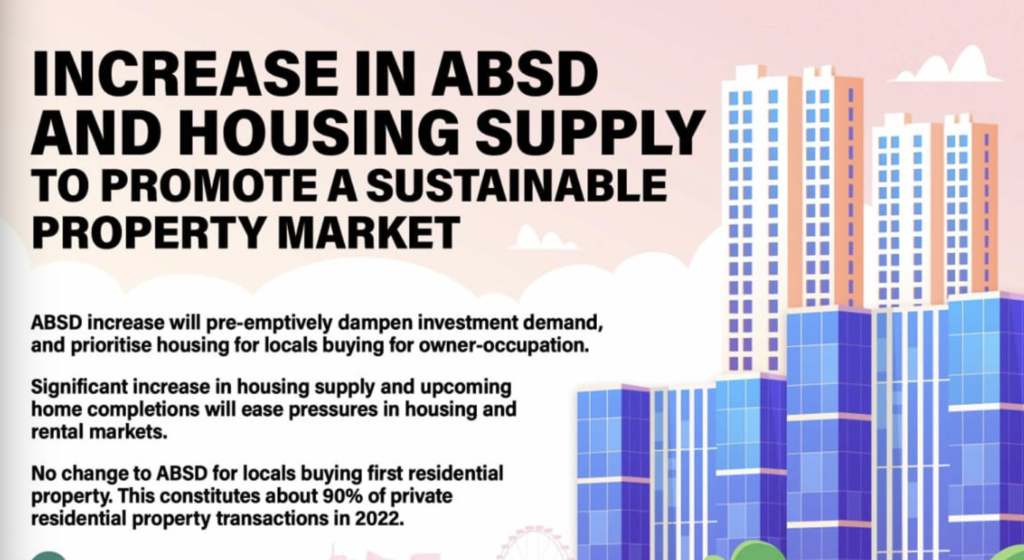
TLDR The impending rise in ABSD (Additional Buyer's Stamp Duty) is expected to suppress investment demand, allowing local homebuyers to...
Read More
Jayson Ang – March 30, 2024 – Share
TLDR The Lease Buyback Scheme (LBS) is gaining traction among older Singaporeans looking to boost their retirement income by selling...
Read More
Jayson Ang – February 27, 2025 – Share
Singapore, a vibrant city-state known for its multicultural heritage and modern marvels, is a treasure trove of unique souvenirs that...
Read More
Jayson Ang – October 9, 2025 – Share
TLDR Freehold properties in Singapore offer indefinite ownership but come with a 15–25% premium over 99-year leasehold units. Despite common...
Read More
Jayson Ang – February 11, 2024 – Share
Madam Tan voiced that approximately two years ago, when her apartment hit its minimum occupation period, she and her spouse...
Read More