
Fraud Blocker
Your search results

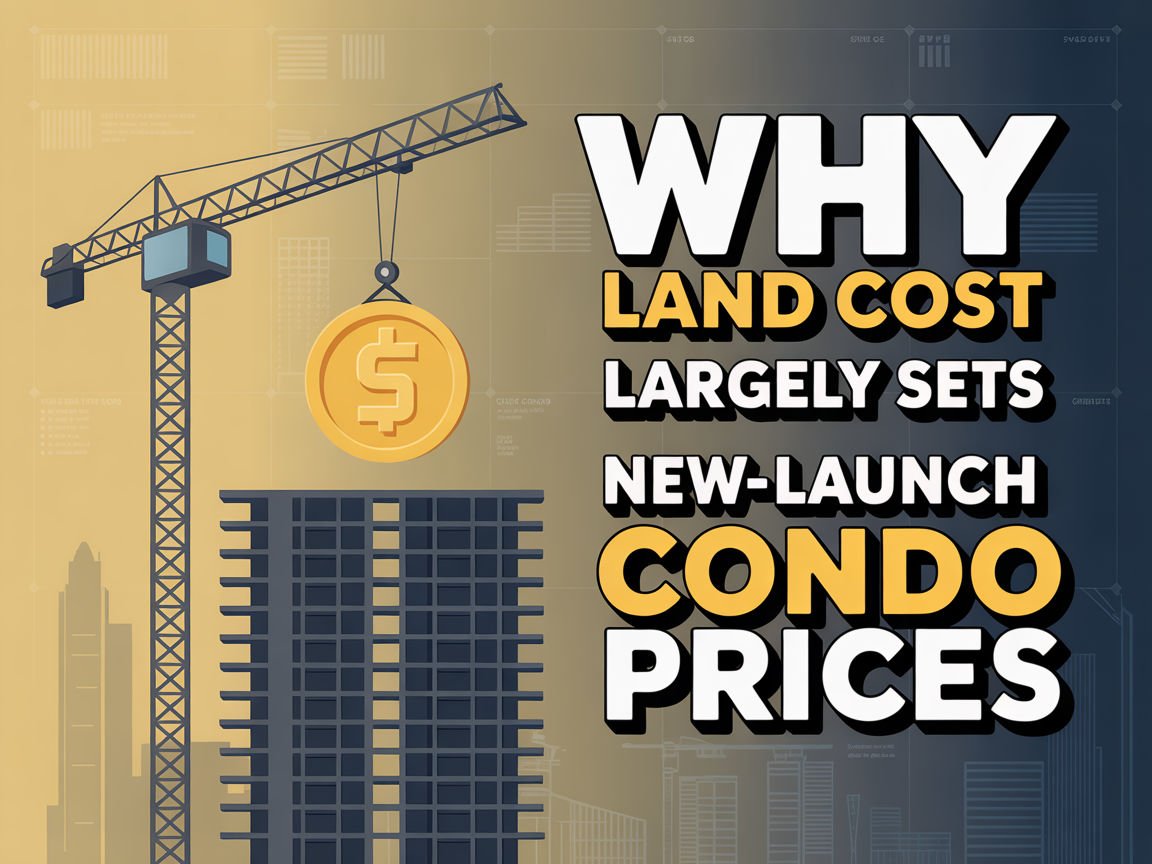
Why Land Cost Largely Sets New‑Launch Condo Prices (And How To Use It To Judge A Fair Launch)

Posted by Jayson Ang on November 2, 2026
0 Comments

TLDR

New‑launch condo prices in Singapore are primarily anchored by land cost, which typically accounts for about 70% of the eventual selling price. Developers add roughly 20% for construction, financing, and contingencies, plus another 10–15% for profit and marketing. This arithmetic sets a breakeven and expected launch band, though premiums may arise from factors like integrated MRT/retail links, project scale, or site complexities. For example, AMO Residence and Canberra Crescent launches closely matched land‑based estimates, while projects like Sceneca and Terra Hill exceeded them due to harmonisation rules or engineering challenges. Buyers can use land bid prices (psf ppr) as a compass: if launch prices fall within the expected band, they’re broadly defensible; if far above, one should question whether location or market hype justifies the premium. Ultimately, land economics provide a practical framework to judge whether a new launch is fairly priced.

Location matters, yes — but the single biggest driver of a developer’s launch price is almost always the land cost. When a developer pays heavily for a plot (via GLS or an en‑bloc), that winning bid creates a hard floor. From there, construction, finance, marketing and profit are stacked on top. Below I explain the basic arithmetic developers use, the common caveats, and how you can use land prices to assess whether a launch looks fair.

A note about launch timing The framework here applies best at the initial launch phase (roughly the first 12 months). Developers tend to raise prices over time if demand is strong, so later rounds usually cost more. If you want a sense of the starting price range, land cost plus a standard markup is the useful guide.

How land cost feeds into pricing Treat land cost as the baseline. When a developer wins a land bid, that ppr (price per plot ratio) or psf figure anchors the minimum they must recover. After that they add:

  • Construction and site works
  • Financing costs
  • Marketing and sales commissions
  • Contingencies and profit margin

Because GLS and en‑bloc bids are typically expressed as psf (ppr), those numbers translate directly into the per‑square‑foot economics of the finished condos. A very high land bid effectively hard‑wires a high breakeven psf.

A simple industry shortcut A commonly used rule of thumb is:

  • Roughly 70% of the eventual selling price reflects land cost (including land‑related levies and fees).
  • The remaining 30% is split between construction/overheads (20%) and developer margin/marketing/commissions (10%–15%).

So, for a plot bought at, say, $1,388 psf ppr, adding ~20% for hard costs gives you a breakeven around $1,666 psf. Add the developer’s margin and marketing (another ~20% on top of breakeven in many seller‑friendly markets) and you get expected launch pricing in the high $1,9xx to low $2,1xx psf range — assuming market conditions allow that margin.

Why it’s not exact Several legitimate reasons push final prices above or below this rule‑of‑thumb:

  • Project scale: mega‑developments spread fixed costs (show flats, marketing) across thousands of units, lowering per‑unit overheads. Small boutique projects have higher per‑unit overheads.
  • Market cycle: in a sellers’ market developers will target fuller margins; in weak markets margins can compress.
  • Site complexity: unusual groundworks (elevations, retaining walls, flood mitigation) or costly infrastructure approvals can add materially to development costs.
  • Policy changes: tightening rules, levy increases or GFA (gross floor area) harmonisation can raise effective psf or reduce saleable area — shifting the maths.
  • Integrated developments: projects with MRT, retail or town‑centre integration often command a premium beyond the simple formula.

Real examples that show the mechanics

  • AMO Residence (Ang Mo Kio Ave 1 GLS) — site awarded at roughly $1,118 psf ppr. Using the +70/+20 approach pointed to launch pricing around $1,900–$2,100 psf. When AMO launched, initial pricing began close to that band and average early sales sat near $2,100 psf — nearly matching the simple model.
  • Canberra Crescent Residences — plot awarded at ~ $721 psf ppr. The formula implied a breakeven of ~$1,200+ psf and a launch band in the high $1,7xx–$2,0xx psf area. Early launches in that market indeed clustered around ~$1,974 psf.
  • Sceneca Residence and Sengkang Grand Residences illustrate how post‑GFA harmonisation and project integration can push launch prices above basic predictions. Sceneca’s site had a lower ppr, but the removal of certain saleable areas after harmonisation raised the effective psf; Sengkang Grand’s integrated MRT/retail link commanded a location premium that lifted pricing well beyond a vanilla ppr‑based estimate.
  • Terra Hill is a cautionary example where site‑specific engineering (elevation, slope stabilisation) added substantial cost. Land bought at about $1,355 psf ppr suggested one breakeven band, but required extra civil works that pushed expected launch prices higher than simple models predicted.

Harmonisation and harmonics: saleable area matters GFA harmonisation (removing aircon ledges and other non‑livable areas from saleable floor area) reduces the saleable sqft the developer can sell. If a site was bought before harmonisation, the developer may need to raise the psf to recoup the same revenue, which pushes launch pricing upward. This is why identical ppr figures can result in different launch psf outcomes depending on when and how the land was acquired.

Practical rules buyers can use

  1. Find the land ppr (or en‑bloc psf) for the site. This is the baseline.
  2. Add ~20% to get a rough breakeven (construction, financing, contingency).
  3. Add another ~20% to estimate a typical developer launch price in a seller’s market.
    If the resulting band is, for example, $1,900–$2,100 psf and the developer’s launch prices are within that range, the pricing is broadly explainable. If they’re far above it, ask why — location premium? integrated links? limited competition? Or is the market simply overheated?

When the formula breaks down

  • A developer may price above the model because the immediate local norm is already high; buyers often expect prices near existing comparable projects, and developers can exploit that.
  • Conversely, if a developer paid an unusually low land price, they might still launch at prevailing market rates to maximise margin — which means lower land cost doesn’t guarantee cheaper launches for buyers.
  • Large integrated or prestige sites (waterfront, direct MRT access) frequently command a premium over the +70/+20 estimate.

How to judge whether a launch is a “good deal”

  • Use the land ppr as your compass: it shows the developer’s minimum and room for margin.
  • Check for project‑specific upward drivers: integration with transport/retail, unique views, or scarcity of alternatives nearby. Those justify premiums above baseline.
  • Compare with nearby recent launches and en‑bloc prices: if the new launch sits well above both land‑based estimates and local norms, be cautious; conversely, pricing comfortably within the expected band can be defensible for early buyers.

Final thoughts The land price is the structural anchor behind most new‑launch pricing. The +70% (land) +20% (hard costs) +20% (margin/marketing) heuristic won’t give you an exact psf, but it tells you where the floor and reasonable launch range lie. Adjust the numbers up for project complexity, integration, and prevailing market appetite; adjust down for scale benefits or weak demand.

If you want, I can run the math for a specific GLS award or en‑bloc price and show the breakeven and plausible launch band. That’s a practical way to see whether a new project’s asking psf is supported by the land economics — or whether you’re just paying landscaping and branding.

Should You Buy, Sell or Wait?

If you’re reading this, you must be trying to figure out the best course of action right now: is it the right time to buy or sell?

It’s difficult to give an exact answer since everyone’s situation is unique and what works for one person may not necessarily work for you.

I can bring you a wealth of on-the-ground experience and a data-driven approach to provide clarity and direction. From beginners to experienced investors, our top-down, objective approach will help you on your real estate journey.

I can help you by:

  1. Offering Strategic Real Estate Advice – I can help create a comprehensive plan to guide you through your property journey.
  2. Connecting Your Home with the Perfect Buyers – Through stunning visuals, an effective communication strategy, and an in-depth knowledge of the market, we’ll ensure your home is presented in the best possible way to fulfill your goals.

You May Also Like …


Top 5 : Reasons why Freehold Properties Cost More in Singapore
Mandarin Top 5

Top 5 : Reasons why Freehold Properties Cost More in Singapore

Freehold properties, a term often heard in the real estate market, are properties that are "free from hold" of any...
Read More

Top 5 Considerations : Uncover the Secrets of Buying Older Properties – What They Won’t Tell You!
Mandarin Top 5

Top 5 Considerations : Uncover the Secrets of Buying Older Properties – What They Won’t Tell You!

Buying an older property can be a dream come true for many homebuyers, as these homes often come with unique...
Read More
5 Tips : How To Buy A Property In Singapore As A Foreigner
Mandarin Top 5

5 Tips : How To Buy A Property In Singapore As A Foreigner

  Singapore's property market is a popular choice for both locals and foreigners looking to invest in real estate. However,...
Read More
Singapore’s Real Estate Market: The 5 Most Important Documents to Review Before Buying a Property
Mandarin Top 5

Singapore’s Real Estate Market: The 5 Most Important Documents to Review Before Buying a Property

Singapore's real estate market is highly regulated and can be complex for those unfamiliar with the process. As a prospective...
Read More
Top 5 Instagram-Worthy Spots in Singapore
Mandarin Top 5

Top 5 Instagram-Worthy Spots in Singapore

Singapore, a beautiful city-state known for its stunning architecture, lush greenery, and vibrant culture, is a photographer's paradise. The island...
Read More
5 Key Insights to Take Away from the Latest 2022 Cooling Measures
All Blog Posts Buying Tips

5 Key Insights to Take Away from the Latest 2022 Cooling Measures

TLDR Affordability of HDB Market: Government is focused on ensuring affordable public housing and may increase supply if needed. Long-term...
Read More
Why Chinese Investors Should Not Be Deterred by ABSD: 5 Reasons
Buying Tips Mandarin Top 5

Why Chinese Investors Should Not Be Deterred by ABSD: 5 Reasons

Why Chinese Investors Should Not Be Deterred by ABSD: 5 Reasons Here are the top 5 reasons why Chinese investors...
Read More
Why It’s Not Financially Sensible to Pay Off Your HDB Flat Home Loan in Advance
All Buying Tips

Why It’s Not Financially Sensible to Pay Off Your HDB Flat Home Loan in Advance

TLDR When deciding whether to repay your HDB flat loan early, consider the limitations of not being able to obtain...
Read More
Great Reasons for Condo Owners to Sell upon Reaching TOP – A Guide to Sub-Sale Transactions
All Opinion Selling Tips

Great Reasons for Condo Owners to Sell upon Reaching TOP – A Guide to Sub-Sale Transactions

TLDR A recent sub-sale transaction in Midtown Modern set a new record with a 2-bedroom home selling at $3,150 psf....
Read More
Downsizing From A Spacious 4-Bedroom Condo To A Cozy 2-Bedder: How I Chose A Condo Over A HDB
All Blog Posts Buying Tips

Downsizing From A Spacious 4-Bedroom Condo To A Cozy 2-Bedder: How I Chose A Condo Over A HDB

TLDR Mdm Sim's decision to trade her four-bedroom house for a two-bedroom condo is explored, highlighting the benefits of right-sizing....
Read More
Singapore Property Bubble Ahead? My Friends Share My Market Predictions
All Blog Posts Opinion

Singapore Property Bubble Ahead? My Friends Share My Market Predictions

TLDR The author delves into various opinions on the Singapore property market for the year 2023. Experts have differing views...
Read More
Top 5 Reasons to Invest in Commercial Property in Singapore – Expert Insights!
Mandarin Top 5

Top 5 Reasons to Invest in Commercial Property in Singapore – Expert Insights!

Singapore, a thriving business hub in Southeast Asia, offers a robust real estate market with diverse investment opportunities. While residential...
Read More
Would It Be More Better To Engage One Property Agent Or Multiple Agents In The Selling Process?
All Selling Tips

Would It Be More Better To Engage One Property Agent Or Multiple Agents In The Selling Process?

TLDR When planning to sell your property, you have the option to work with one agent exclusively or non-exclusively. Engaging...
Read More
5 Things to do When You Go For A Property Viewing In Singapore
Buying Tips Mandarin Top 5

5 Things to do When You Go For A Property Viewing In Singapore

5 Things to do When You Go For A Property Viewing In Singapore Here are 5 things to keep in...
Read More
5 Exciting Trends Shaping Singapore’s Property Market for Future Buyers After 2024
All Buying Tips

5 Exciting Trends Shaping Singapore’s Property Market for Future Buyers After 2024

TLDR When it comes to the evolving landscape of property development in Singapore, developers are facing new challenges and opportunities....
Read More
5 Impacts Of The Singapore-Malaysia High-Speed Rail On The Property Market
Mandarin Top 5

5 Impacts Of The Singapore-Malaysia High-Speed Rail On The Property Market

The proposed Singapore-Malaysia High-Speed Rail (HSR) is a joint project between the two countries that aims to improve connectivity and...
Read More
Case Study : With Income Of $180K per Annum, Which Options Should I Choose?
All Blog Posts Opinion

Case Study : With Income Of $180K per Annum, Which Options Should I Choose?

TLDR When making property decisions in Singapore, it's crucial to consider various factors like affordability, loan-to-value ratios, and CPF requirements....
Read More
Mega Developments vs. Regular Condos in Singapore: A Data-Driven Comparison
All Buying Tips Opinion

Mega Developments vs. Regular Condos in Singapore: A Data-Driven Comparison

TLDR Mega-developments (1,000+ units) in Singapore, once seen as chaotic, now offer competitive pricing and extensive facilities, making them attractive...
Read More
A Step-by-Step Guide To Upgrading From an HDB Flat To Your a Private Property
All Blog Posts Buying Tips

A Step-by-Step Guide To Upgrading From an HDB Flat To Your a Private Property

TLDR Understanding the complexities of upgrading from an HDB flat to a private property in Singapore involves selling your HDB...
Read More
Is Lentor Mansion: The 5th New Lentor Condo in 2 Years Still Worth Your Attention?
All Buying Tips Opinion

Is Lentor Mansion: The 5th New Lentor Condo in 2 Years Still Worth Your Attention?

TLDR for "Exciting Updates from Lentor Mansion" Lentor Mansion, a new project in the vibrant Lentor region, is set to...
Read More
1 … 3 4 5 6 7 … 37

Compare Listings