



Increased Seller’s Stamp Duty (SSD) Rates in Singapore: Implications for Buyers and Sellers
TLDR From July 4, 2025, Singapore reinstates Seller’s Stamp Duty (SSD) rates to 2017 levels, with rates of 16%, 12%,...
Read More

TLDR
Smaller household sizes in Singapore do not automatically mean people need smaller homes. Shared spaces such as kitchens, living rooms, dining areas, storage, and circulation space remain necessary regardless of how many people live there. Modern lifestyles also place heavier demands on homes, especially for remote work, privacy, caregiving, ageing in place, and mental well-being.
Compact layouts may look efficient on paper, but reduced corridors, tiny bedrooms, multipurpose rooms, and limited sound separation can affect daily comfort over time. Singles, couples, retirees, and small families may all need more functional space than square-footage-per-person figures suggest.
Smaller homes can be affordable and suitable for some buyers, but buyers should assess how a property supports future needs, not only current furniture or price. A liveable home should balance affordability with privacy, flexibility, accessibility, and long-term comfort.
Singapore homes are getting smaller, but does having fewer people under one roof really mean we need less living space? I think there’s more to this argument than the numbers suggest.
If there’s one way to spark a heated discussion among Singapore homeowners, it’s to suggest that shrinking homes aren’t a problem because families are getting smaller too.
It’s an argument that sounds perfectly reasonable on paper. After all, if a household has fewer occupants, shouldn’t it naturally need less space?
This debate has been around for years, particularly when concerns about shrinking HDB flat sizes started attracting more attention around 2020.
Interestingly, the most significant reduction in HDB flat sizes actually occurred between the 1970s and 1980s. From the 2000s onwards, flat sizes have remained relatively consistent.
But the broader argument hasn’t changed much.
We’re often told that even if our homes have become smaller, the amount of living space available per person hasn’t necessarily decreased.
Put simply, if a family of five previously occupied a larger flat, and a family of three now occupies a smaller one, the difference supposedly balances out.
But here’s what I think we’re overlooking: living space isn’t just about how many square feet each person gets. It’s about what that space allows us to do.
And that’s where the real problem begins.
Let’s first look at why this argument has gained so much traction.
According to a report by The Business Times, the average HDB household size declined from 3.1 people in 2018 to 3.0 people in 2023/24.
Meanwhile, the number of Singaporeans and Permanent Residents living in HDB flats increased from approximately 3.15 million in 2018 to 3.18 million in 2023.
The more interesting changes, however, are happening in how Singaporeans choose to live.
Consider these findings:
These numbers tell us something important about Singapore’s changing housing needs.
We may have fewer people living together, but that doesn’t necessarily translate into weaker housing demand.
In fact, the opposite could happen.
Imagine a household of five eventually splitting into three separate households. The total number of people hasn’t increased, but the number of homes required has tripled.
Combine this with population growth, and you can see why smaller households may continue supporting demand for both private properties and HDB resale flats.
However, while the implications for property prices are worth discussing, there’s another issue that deserves just as much attention.
Are we compromising our living standards by assuming that smaller households can comfortably make do with smaller homes?
I don’t think the answer is as straightforward as some would like to believe.
One of the biggest problems with using square footage per person is the assumption that space requirements work like a mathematical formula.
If four people need 1,000 sq ft, does that mean three people only need 750 sq ft?
And should someone living alone be perfectly comfortable in a 250 sq ft apartment?
Of course not.
That’s because certain areas of a home serve important functions regardless of how many people live there.
Take the kitchen, for example.
Whether you’re preparing meals for yourself or a family of four, you’d probably still appreciate having enough countertop space, storage, and room to move around.
The same goes for your dining area.
A person living alone doesn’t suddenly stop needing a proper place to sit down for meals.
And even if you live by yourself, wouldn’t you still want a comfortable living room where you can relax or entertain friends?
These are basic aspects of everyday living that don’t disappear simply because fewer people occupy the property.
A home isn’t just a collection of individual spaces allocated to its occupants.
It’s a combination of shared areas, private rooms, storage, and circulation space that makes daily life practical and comfortable.
When these elements are squeezed too tightly, something eventually has to give.
Here’s another consideration that I think is frequently underestimated.
The way Singaporeans use their homes has changed considerably.
For many people, home is no longer just somewhere to eat, sleep, and relax after work.
It’s also their office.
And in some cases, it serves as a gym, entertainment room, study area, and occasional meeting space.
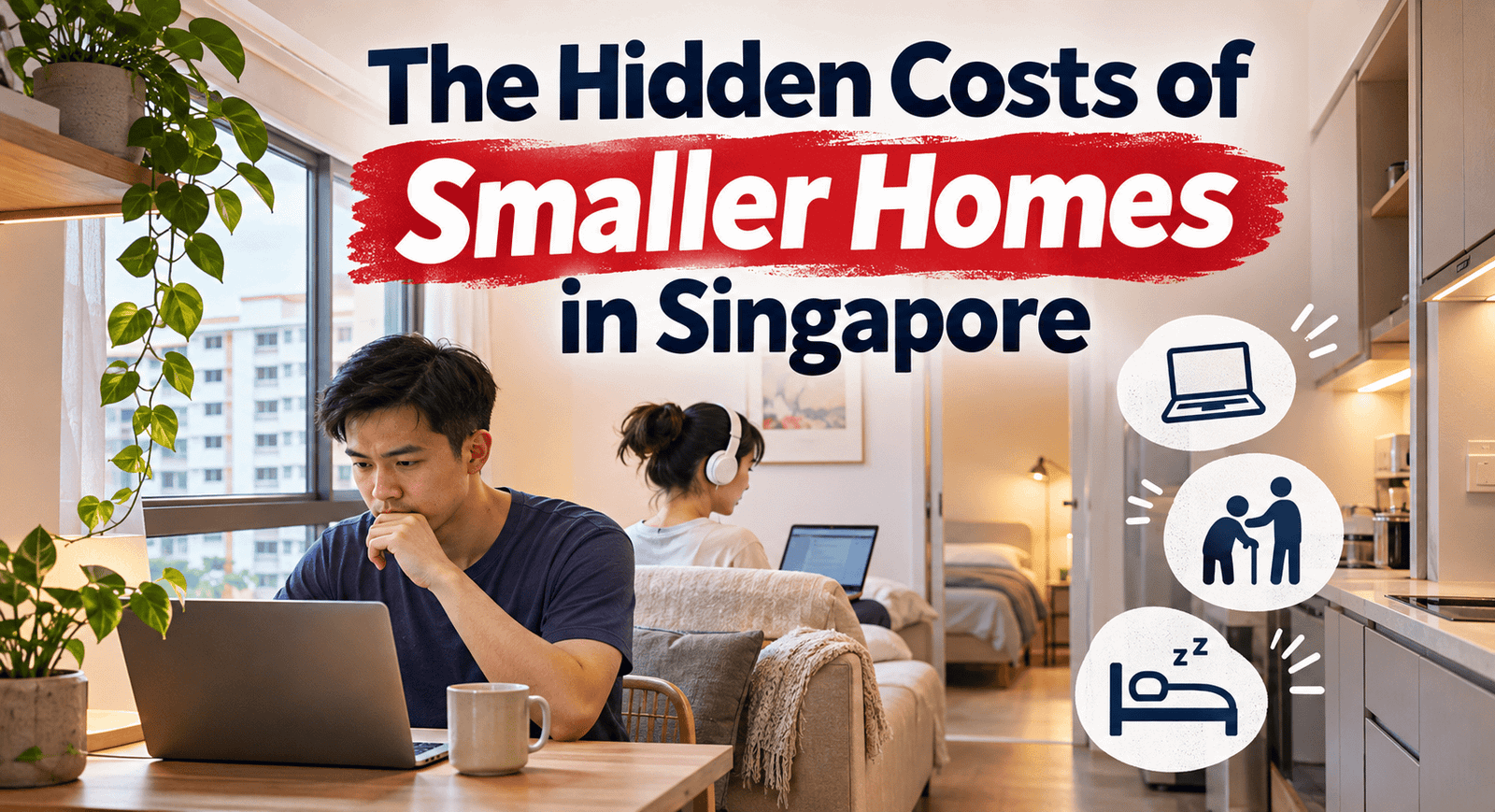
Now imagine a couple living in a compact two-bedroom condominium.
On paper, the arrangement seems perfectly adequate.
There’s a master bedroom, another room that can function as a study, and a combined living and dining area.
But what happens when both partners need to attend video meetings simultaneously?
One might use the study, while the other works from the bedroom or dining table.
That’s manageable until one person needs complete silence, another has an important presentation, or someone wants to prepare lunch.
Suddenly, an otherwise efficient layout starts feeling restrictive.
The problem becomes even more apparent when the occupants have different routines.
Perhaps one partner works late into the night while the other needs to wake up early.
Or one enjoys gaming in the living room while the other prefers to sleep early.
Even an efficiently designed condominium layout can create problems if sound travels easily between rooms.
Take the popular dumbbell layout, where bedrooms sit on opposite sides of the living area.
It’s often praised for eliminating unnecessary corridors and maximising usable space.
And rightly so.
But depending on the design, anyone moving through the living room late at night could still disturb someone trying to sleep.
A more traditional layout with additional corridor space might look less efficient on the floor plan, but it can offer better separation between different parts of the home.
This is why I don’t believe layout efficiency should always be measured by how much corridor space a developer manages to eliminate.
Sometimes, the seemingly wasted space is precisely what makes a home more liveable.
There’s a tendency to associate privacy concerns with larger families.
After all, a household with several children will naturally have more competing demands for personal space.
But privacy matters just as much in smaller households.
In fact, couples who spend substantial amounts of time together may value the ability to retreat into separate rooms even more.
Anyone who’s lived with a partner long enough will probably understand this.
Sometimes, you don’t need a serious disagreement to want a little breathing room.
You might simply want to read quietly while your partner watches television.
Or perhaps you want to finish some work without listening to someone else’s phone conversation.
These aren’t extravagant lifestyle demands.
They’re ordinary aspects of sharing a home.
And when every room is designed to serve several purposes, finding that separation becomes increasingly difficult.
A couple living in a compact apartment might technically have enough space for their furniture and belongings.
But that doesn’t automatically mean they have enough space to live comfortably alongside each other.
There’s a difference between having sufficient room to fit everything in and having sufficient room to enjoy daily life.
It’s a distinction worth remembering whenever we compare properties based purely on their square footage.
Another assumption I frequently hear is that people naturally need less space as they grow older.
The reasoning usually goes something like this:
The children have moved out, there’s no longer a need for multiple bedrooms, and maintaining a large property becomes increasingly troublesome.
So downsizing seems like the logical choice.
And to be fair, downsizing can absolutely make sense for many retirees.
A smaller home may mean lower maintenance costs, less cleaning, and potentially more cash available for retirement.
But there’s an important detail that often gets missed.
Growing older doesn’t necessarily mean your physical space requirements become smaller. In some circumstances, they may actually increase.
Consider an elderly couple where one partner eventually requires a wheelchair or walking aid.
Their home may need wider passageways, fewer obstacles, and sufficient room to manoeuvre safely.
If a caregiver is needed, there must also be enough space for someone to assist with daily activities.
Depending on the resident’s health needs, additional room may be required for medical equipment, mobility aids, or an adjustable bed.
A home that once felt spacious enough for two healthy adults could suddenly become difficult to navigate.
And here’s something that doesn’t always show up when you’re studying a floor plan.
A narrow corridor might be perfectly acceptable when you’re young and mobile.
But that same corridor could become a significant obstacle when someone needs assistance moving between rooms.
Likewise, a tightly configured bathroom may work well for an able-bodied resident but become impractical when a wheelchair or caregiver is involved.
This is why ageing-in-place design deserves more attention in conversations about shrinking homes.
Singapore’s ageing population means more homeowners may eventually have to consider these requirements.
And if we keep reducing living spaces based on the assumption that older households need less room, we risk overlooking the very people who may benefit most from having additional functional space.
There’s also a less visible consequence of smaller homes.
The effect on our mental well-being.
Research examining compact housing in densely populated cities has identified associations between limited living space and issues such as increased stress, poorer sleep, and reduced psychological well-being.
Of course, housing quality, household relationships, income, and personal circumstances also influence these outcomes.
It would be too simplistic to suggest that everyone living in a small apartment will automatically experience poor mental health.
But the relationship between our living environment and psychological comfort shouldn’t be dismissed.
Think about a studio apartment where the same area serves as your bedroom, office, dining room, and entertainment space.
You wake up, reach for your laptop, and start working.
When lunchtime comes, you eat at the same desk.
After dinner, you watch Netflix or play games just a few steps from your bed.
And when it’s finally time to sleep, you’re still surrounded by reminders of everything you’ve been doing throughout the day.
There’s little physical separation between work, leisure, and rest.
This can make it harder to switch off mentally.
It’s one reason people are often encouraged to maintain a distinction between their sleeping environment and activities that keep them mentally stimulated.
Now, having a dedicated bedroom doesn’t guarantee better sleep.
But when your entire home effectively functions as one multipurpose room, creating those boundaries becomes much more challenging.
And for someone who works remotely most of the week, these limitations may feel even more pronounced.
A person living alone might spend more hours at home than a larger family whose members are frequently out at school or work.
So the idea that singles automatically need less space deserves some reconsideration.
The amount of time we spend at home, and what we do during those hours, can matter just as much as the number of occupants.
If you’ve been following Singapore’s private residential market, you’ll probably have noticed how compact layouts have become increasingly common.
Two-bedroom condominiums, for example, are no longer exclusively associated with singles, young couples, or investors.
Some small families are also considering them because larger units have become financially difficult to afford.
It’s understandable.
When property prices rise faster than household budgets, buyers naturally adjust their expectations.
A family that previously aimed for a three-bedroom condominium might decide that a two-bedroom unit is a more realistic option.
Developers have also become increasingly creative in designing layouts that accommodate multiple functions within limited square footage.
We see bedrooms that barely have enough clearance around the bed, compact kitchens integrated into living spaces, and study corners marketed as flexible work areas.
And I should point out that there’s nothing inherently wrong with a smaller property.
For the right buyer, a well-designed compact home can be an excellent choice.
The concern is what happens when smaller homes stop being one option among many and become the expected standard.
HDB flats have generally seen less dramatic changes in recent decades compared to some newer private condominium developments.
Nevertheless, the broader direction raises an important question.
At what point does making a layout more efficient stop improving the home and start reducing the quality of living?
Because there’s only so much clever design can accomplish.
You can replace a conventional dining table with a foldable one.
You can install storage beneath your bed.
You can use sliding doors, built-in furniture, and multipurpose fittings to maximise every available corner.
But none of these solutions actually creates additional floor space.
They simply help you work around having less of it.
And sometimes, these compromises accumulate without homeowners fully realising it.
I think the most concerning aspect of shrinking homes is how easily we adjust our expectations.
At first, the compromises seem minor.
You choose a smaller dining table because the larger one would obstruct the walkway.
Then you decide that a study room isn’t essential because you can work from the bedroom.
Perhaps you give up the idea of having a guest room.
Or you decide that hosting friends at home isn’t practical, so you’ll meet them outside instead.
Individually, none of these decisions seems particularly significant.
But over time, the limitations begin influencing how you live.
You avoid inviting relatives over because there isn’t enough seating.
You struggle to find a quiet corner when both partners have work calls.
You realise there’s nowhere to store larger household items without cluttering the living room.
And when ageing parents eventually need additional support, you discover that accommodating them would require major changes to your living arrangements.
What’s especially interesting is that many of these compromises may not feel like sacrifices at the point of purchase.
After all, an empty showroom unit can look remarkably spacious.
Without the clutter of everyday life, compact bedrooms and living areas can appear perfectly adequate.
It’s only after moving in, furnishing the home, and living there for several years that certain limitations become obvious.
By then, moving to a larger property could involve substantial transaction costs, higher mortgage commitments, and considerable disruption.
That’s why I believe buyers should look beyond whether a home can accommodate their current furniture.
They should also consider whether it can support the way their lives might change.
I don’t think the solution is to insist that every household needs a large home.
That wouldn’t be realistic, especially in land-scarce Singapore.
And for some people, smaller homes offer genuine advantages.
They may be more affordable, easier to maintain, and better suited to a minimalist lifestyle.
But we also shouldn’t assume that smaller household sizes automatically justify shrinking homes.
The amount of space someone needs depends on much more than the number of people living together.
It depends on their daily routines, working arrangements, mobility requirements, privacy needs, and future plans.
A single professional who works entirely from home may have very different requirements from someone who spends most of the day outside.
A retired couple with mobility challenges may need more accessible floor space than a younger couple with the same number of occupants.
And a family with one child may value an additional room just as much as a larger family does.
This is why square footage per person, while useful as a statistical measure, doesn’t tell us everything about housing quality.
Neither does the efficiency of a floor plan.
An apartment can be exceptionally efficient in terms of how its space is allocated and still feel uncomfortable to live in.
Conversely, a slightly larger home with more separation between rooms may provide greater flexibility over the years.
For buyers, I think the key is to consider not just whether the home is suitable for your life today, but whether it can continue accommodating your needs five, ten, or even twenty years from now.
That doesn’t mean everyone should stretch their finances to purchase a larger property.
Affordability still matters, and taking on an excessive mortgage simply to gain another bedroom can create a different set of problems.
Instead, it’s about recognising that floor space has value beyond its price per square foot.
It affects how we work, rest, socialise, care for family members, and ultimately experience our homes.
Singapore’s housing landscape will continue evolving as household structures change, land remains limited, and property prices influence what buyers can afford.
Smaller homes will undoubtedly remain part of that landscape.
And there’s nothing wrong with that.
What worries me is the tendency to treat shrinking household sizes as sufficient justification for reducing living spaces further.
Because the relationship simply isn’t that straightforward.
A home is more than a mathematical allocation of square footage among its occupants.
It’s where we spend a significant part of our lives, build relationships, recover from stressful days, and adapt to different stages of adulthood.
Some of those needs remain unchanged whether we live alone or with four other people.
Others may actually become more demanding as we grow older.
So perhaps instead of asking how small Singapore homes can become while remaining technically functional, we should be asking a different question.
How much space do we really need to maintain a reasonable quality of life?
And more importantly, are we gradually lowering our expectations simply because we’ve become accustomed to making do with less?
That’s a conversation worth having before smaller homes become so normal that we stop questioning what we’ve given up.
If you’re considering buying, downsizing, or upgrading your property in Singapore, don’t assess a home based on price and square footage alone. At Jayson Ang, I believe the right property should support both your financial goals and the way you want to live. Sometimes, the best property decision isn’t about maximising every dollar or every square foot, but finding the right balance between affordability, comfort, and long-term flexibility.
If you’re reading this, you must be trying to figure out the best course of action right now: is it the right time to buy or sell?
It’s difficult to give an exact answer since everyone’s situation is unique and what works for one person may not necessarily work for you.
I can bring you a wealth of on-the-ground experience and a data-driven approach to provide clarity and direction. From beginners to experienced investors, our top-down, objective approach will help you on your real estate journey.
I can help you by:


You May Also Like …