



Fraud Blocker
Your search results

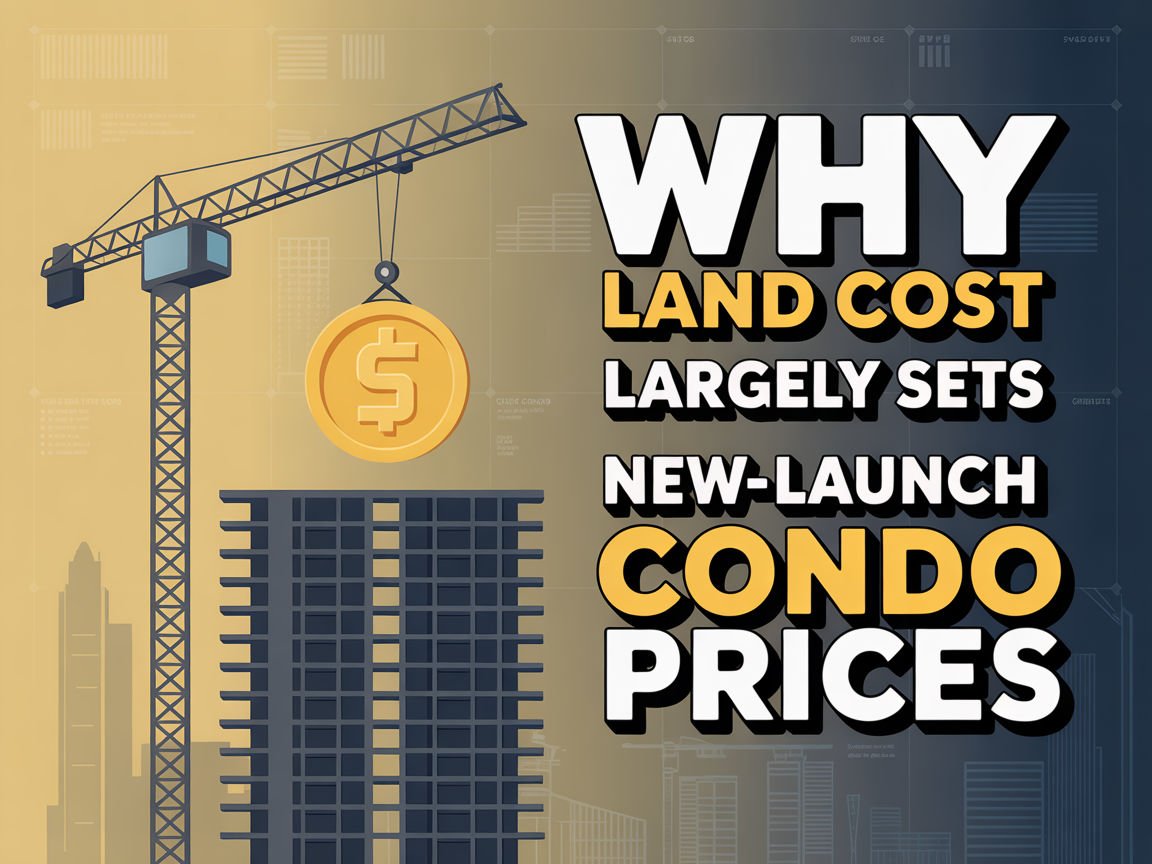
Why Land Cost Largely Sets New‑Launch Condo Prices (And How To Use It To Judge A Fair Launch)

Posted by Jayson Ang on November 2, 2026
0 Comments

TLDR

New‑launch condo prices in Singapore are primarily anchored by land cost, which typically accounts for about 70% of the eventual selling price. Developers add roughly 20% for construction, financing, and contingencies, plus another 10–15% for profit and marketing. This arithmetic sets a breakeven and expected launch band, though premiums may arise from factors like integrated MRT/retail links, project scale, or site complexities. For example, AMO Residence and Canberra Crescent launches closely matched land‑based estimates, while projects like Sceneca and Terra Hill exceeded them due to harmonisation rules or engineering challenges. Buyers can use land bid prices (psf ppr) as a compass: if launch prices fall within the expected band, they’re broadly defensible; if far above, one should question whether location or market hype justifies the premium. Ultimately, land economics provide a practical framework to judge whether a new launch is fairly priced.

Location matters, yes — but the single biggest driver of a developer’s launch price is almost always the land cost. When a developer pays heavily for a plot (via GLS or an en‑bloc), that winning bid creates a hard floor. From there, construction, finance, marketing and profit are stacked on top. Below I explain the basic arithmetic developers use, the common caveats, and how you can use land prices to assess whether a launch looks fair.

A note about launch timing The framework here applies best at the initial launch phase (roughly the first 12 months). Developers tend to raise prices over time if demand is strong, so later rounds usually cost more. If you want a sense of the starting price range, land cost plus a standard markup is the useful guide.

How land cost feeds into pricing Treat land cost as the baseline. When a developer wins a land bid, that ppr (price per plot ratio) or psf figure anchors the minimum they must recover. After that they add:

  • Construction and site works
  • Financing costs
  • Marketing and sales commissions
  • Contingencies and profit margin

Because GLS and en‑bloc bids are typically expressed as psf (ppr), those numbers translate directly into the per‑square‑foot economics of the finished condos. A very high land bid effectively hard‑wires a high breakeven psf.

A simple industry shortcut A commonly used rule of thumb is:

  • Roughly 70% of the eventual selling price reflects land cost (including land‑related levies and fees).
  • The remaining 30% is split between construction/overheads (20%) and developer margin/marketing/commissions (10%–15%).

So, for a plot bought at, say, $1,388 psf ppr, adding ~20% for hard costs gives you a breakeven around $1,666 psf. Add the developer’s margin and marketing (another ~20% on top of breakeven in many seller‑friendly markets) and you get expected launch pricing in the high $1,9xx to low $2,1xx psf range — assuming market conditions allow that margin.

Why it’s not exact Several legitimate reasons push final prices above or below this rule‑of‑thumb:

  • Project scale: mega‑developments spread fixed costs (show flats, marketing) across thousands of units, lowering per‑unit overheads. Small boutique projects have higher per‑unit overheads.
  • Market cycle: in a sellers’ market developers will target fuller margins; in weak markets margins can compress.
  • Site complexity: unusual groundworks (elevations, retaining walls, flood mitigation) or costly infrastructure approvals can add materially to development costs.
  • Policy changes: tightening rules, levy increases or GFA (gross floor area) harmonisation can raise effective psf or reduce saleable area — shifting the maths.
  • Integrated developments: projects with MRT, retail or town‑centre integration often command a premium beyond the simple formula.

Real examples that show the mechanics

  • AMO Residence (Ang Mo Kio Ave 1 GLS) — site awarded at roughly $1,118 psf ppr. Using the +70/+20 approach pointed to launch pricing around $1,900–$2,100 psf. When AMO launched, initial pricing began close to that band and average early sales sat near $2,100 psf — nearly matching the simple model.
  • Canberra Crescent Residences — plot awarded at ~ $721 psf ppr. The formula implied a breakeven of ~$1,200+ psf and a launch band in the high $1,7xx–$2,0xx psf area. Early launches in that market indeed clustered around ~$1,974 psf.
  • Sceneca Residence and Sengkang Grand Residences illustrate how post‑GFA harmonisation and project integration can push launch prices above basic predictions. Sceneca’s site had a lower ppr, but the removal of certain saleable areas after harmonisation raised the effective psf; Sengkang Grand’s integrated MRT/retail link commanded a location premium that lifted pricing well beyond a vanilla ppr‑based estimate.
  • Terra Hill is a cautionary example where site‑specific engineering (elevation, slope stabilisation) added substantial cost. Land bought at about $1,355 psf ppr suggested one breakeven band, but required extra civil works that pushed expected launch prices higher than simple models predicted.

Harmonisation and harmonics: saleable area matters GFA harmonisation (removing aircon ledges and other non‑livable areas from saleable floor area) reduces the saleable sqft the developer can sell. If a site was bought before harmonisation, the developer may need to raise the psf to recoup the same revenue, which pushes launch pricing upward. This is why identical ppr figures can result in different launch psf outcomes depending on when and how the land was acquired.

Practical rules buyers can use

  1. Find the land ppr (or en‑bloc psf) for the site. This is the baseline.
  2. Add ~20% to get a rough breakeven (construction, financing, contingency).
  3. Add another ~20% to estimate a typical developer launch price in a seller’s market.
    If the resulting band is, for example, $1,900–$2,100 psf and the developer’s launch prices are within that range, the pricing is broadly explainable. If they’re far above it, ask why — location premium? integrated links? limited competition? Or is the market simply overheated?

When the formula breaks down

  • A developer may price above the model because the immediate local norm is already high; buyers often expect prices near existing comparable projects, and developers can exploit that.
  • Conversely, if a developer paid an unusually low land price, they might still launch at prevailing market rates to maximise margin — which means lower land cost doesn’t guarantee cheaper launches for buyers.
  • Large integrated or prestige sites (waterfront, direct MRT access) frequently command a premium over the +70/+20 estimate.

How to judge whether a launch is a “good deal”

  • Use the land ppr as your compass: it shows the developer’s minimum and room for margin.
  • Check for project‑specific upward drivers: integration with transport/retail, unique views, or scarcity of alternatives nearby. Those justify premiums above baseline.
  • Compare with nearby recent launches and en‑bloc prices: if the new launch sits well above both land‑based estimates and local norms, be cautious; conversely, pricing comfortably within the expected band can be defensible for early buyers.

Final thoughts The land price is the structural anchor behind most new‑launch pricing. The +70% (land) +20% (hard costs) +20% (margin/marketing) heuristic won’t give you an exact psf, but it tells you where the floor and reasonable launch range lie. Adjust the numbers up for project complexity, integration, and prevailing market appetite; adjust down for scale benefits or weak demand.

If you want, I can run the math for a specific GLS award or en‑bloc price and show the breakeven and plausible launch band. That’s a practical way to see whether a new project’s asking psf is supported by the land economics — or whether you’re just paying landscaping and branding.

Should You Buy, Sell or Wait?

If you’re reading this, you must be trying to figure out the best course of action right now: is it the right time to buy or sell?

It’s difficult to give an exact answer since everyone’s situation is unique and what works for one person may not necessarily work for you.

I can bring you a wealth of on-the-ground experience and a data-driven approach to provide clarity and direction. From beginners to experienced investors, our top-down, objective approach will help you on your real estate journey.

I can help you by:

  1. Offering Strategic Real Estate Advice – I can help create a comprehensive plan to guide you through your property journey.
  2. Connecting Your Home with the Perfect Buyers – Through stunning visuals, an effective communication strategy, and an in-depth knowledge of the market, we’ll ensure your home is presented in the best possible way to fulfill your goals.

You May Also Like …


5 Frequently Heard Sales Pitches from Agents Encouraging You to Choose a New Development Instead of a Resale Condo: How Accurate Are They?
All Buying Tips Opinion

5 Frequently Heard Sales Pitches from Agents Encouraging You to Choose a New Development Instead of a Resale Condo: How Accurate Are They?

TLDR While some agents may discourage resale condos due to personal incentives, the difference in profits between resale and new...
Read More

HDB’s Policy Shift for Young Couples: Progressive Step or Cause for Concern?
All Buying Tips Opinion

HDB’s Policy Shift for Young Couples: Progressive Step or Cause for Concern?

TLDR Starting July 2025, HDB will let young couples—where at least one partner is a full-time student or NSF—defer income...
Read More
Singapore Living: 5 Must-Know Factors for Choosing the Perfect Neighborhood
Buying Tips Mandarin Top 5

Singapore Living: 5 Must-Know Factors for Choosing the Perfect Neighborhood

Singapore Living: 5 Must-Know Factors for Choosing the Perfect Neighborhood When it comes to purchasing a property in Singapore, the...
Read More
Top 5 Reasons : Why Do Singaporeans Still Flood The Property Market?
Mandarin Top 5

Top 5 Reasons : Why Do Singaporeans Still Flood The Property Market?

Singapore's property market has been a hot topic of discussion for many years, with its resilience and growth attracting both...
Read More
Market Mistakes in Property Investment: Key Lessons and Strategies for Success
All Buying Tips Opinion Selling Tips

Market Mistakes in Property Investment: Key Lessons and Strategies for Success

TLDR In property investment, common mistakes include lack of research, overleveraging, and neglecting due diligence. To succeed, conduct thorough market...
Read More
6 Indicators and Measures to Determine if Your Home Has Unrecognized Profits
All Blog Posts Buying Tips Opinion Selling Tips

6 Indicators and Measures to Determine if Your Home Has Unrecognized Profits

TLDR The booming real estate market presents opportunities for homeowners to profit from selling their properties. Two key signs that...
Read More
Neighbourhood Estate Guide: Is Holland Village the Most Charming and Relaxed of HDB Estates?
All Buying Tips Opinion

Neighbourhood Estate Guide: Is Holland Village the Most Charming and Relaxed of HDB Estates?

According to the 2014 master plan, Holland Village was given the prestigious title of an "identity node," confirming its status...
Read More
Should We Upgrade to a Condo Now or Wait for Interest Rates to Go Down?
All Blog Posts Buying Tips

Should We Upgrade to a Condo Now or Wait for Interest Rates to Go Down?

TLDR Considering the Singapore property market trends and financial factors, it's crucial to make informed decisions about upgrading from an...
Read More
Why It’s Not Financially Sensible to Pay Off Your HDB Flat Home Loan in Advance
All Buying Tips

Why It’s Not Financially Sensible to Pay Off Your HDB Flat Home Loan in Advance

TLDR When deciding whether to repay your HDB flat loan early, consider the limitations of not being able to obtain...
Read More
Top 5 Considerations : Uncover the Secrets of Buying Older Properties – What They Won’t Tell You!
Mandarin Top 5

Top 5 Considerations : Uncover the Secrets of Buying Older Properties – What They Won’t Tell You!

Buying an older property can be a dream come true for many homebuyers, as these homes often come with unique...
Read More
Has Singapore’s Definition of “Prime” Shifted Now That Fringe Homes Hit $2,000 PSF?
All Buying Tips Opinion

Has Singapore’s Definition of “Prime” Shifted Now That Fringe Homes Hit $2,000 PSF?

TLDR Singapore’s definition of “prime” property is shifting as fringe homes in the Outside Central Region (OCR) now command prices...
Read More
Top 5 : How Does Investing In Luxury Condos In Singapore Compare To Investing In Other Real Estate Asset Classes In Terms Of Long-Term Capital Appreciation?
Mandarin Top 5

Top 5 : How Does Investing In Luxury Condos In Singapore Compare To Investing In Other Real Estate Asset Classes In Terms Of Long-Term Capital Appreciation?

Investing in real estate has long been considered a reliable way to build wealth and diversify one's investment portfolio. In...
Read More
Unveiling the Secrets: How Foreigners Can Buy Property in Singapore – 6 Essential Steps to Follow
All Blog Posts Buying Tips

Unveiling the Secrets: How Foreigners Can Buy Property in Singapore – 6 Essential Steps to Follow

TLDR Foreign investors find Singapore attractive due to its stable governance and transparent business practices. Foreigners, including Permanent Residents (PRs),...
Read More
5 Singapore’s Best Property Investments for 2023: Where to Find Growth and Income
Mandarin Top 5

5 Singapore’s Best Property Investments for 2023: Where to Find Growth and Income

The Singapore property market has long been a sought-after investment destination, with its stable economy and growing population making it...
Read More
Singapore Distressed Property Market in 2025: Separating Fact from Fiction
All Buying Tips Opinion

Singapore Distressed Property Market in 2025: Separating Fact from Fiction

TLDR Mortgagee sale listings in Singapore rose in Q1 2025, mainly due to higher interest rates in recent years. Despite...
Read More
Top 5 Tips : How to Choose the Best Property Agent in Singapore – Insider Tips and Strategies!
Mandarin Top 5

Top 5 Tips : How to Choose the Best Property Agent in Singapore – Insider Tips and Strategies!

Choosing the right property agent in Singapore can be a daunting task, especially with the plethora of options available. A...
Read More
Timing the Singapore Property Market: A Data-Driven Analysis
All Buying Tips Opinion Selling Tips

Timing the Singapore Property Market: A Data-Driven Analysis

TLDR Historical data of Singapore’s property market shows seasonal trends: Q1 (January to March) often has price dips, making it...
Read More
HDB Market Outlook 2023
All Blog Posts

HDB Market Outlook 2023

TLDR: Understanding the HDB Market Outlook 2023 The HDB resale market showed resilience in 2022, with significant growth in sales...
Read More
What Might Occur If We Ease Property Cooling Measures?
All Opinion

What Might Occur If We Ease Property Cooling Measures?

TLDR To assess if Singapore’s property cooling measures are working, compare our actions with China, which is applying the opposite...
Read More
Top 5 : Greatest Challenges That Investors Face In Singapore’s Real Estate Market
Mandarin Top 5

Top 5 : Greatest Challenges That Investors Face In Singapore’s Real Estate Market

Singapore's real estate market is a dynamic and attractive investment landscape for both local and international investors. Known for its...
Read More
1 … 11 12 13 14 15 … 37

Compare Listings