
Fraud Blocker
Your search results

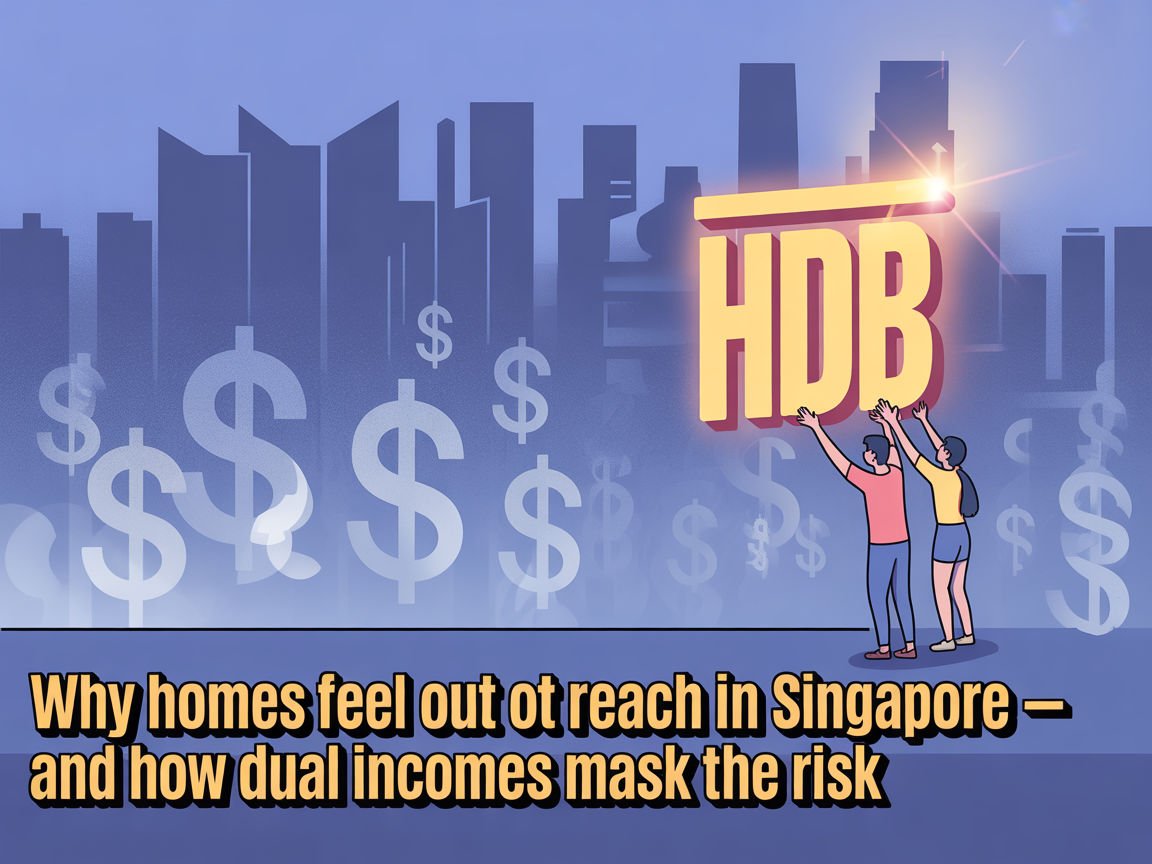
Why Homes Feel Out of Reach in Singapore — and How Dual Incomes Mask the Risk

Posted by Jayson Ang on October 13, 2026
0 Comments

TLDR

Singapore’s housing affordability crisis is increasingly masked by dual-income households. Rising property prices make single-income ownership nearly impossible, pushing families to rely on both partners’ earnings. While this creates the illusion of affordability, it also heightens financial vulnerability: if one income is lost due to job cuts, illness, or caregiving needs, mortgage stress quickly follows. The cultural shift toward dual incomes has normalized higher property prices, but it also erodes resilience, leaving households exposed to economic shocks. At the same time, developers and policymakers often overlook this fragility, focusing on aggregate affordability metrics rather than household-level risks. Ultimately, the reliance on dual incomes sustains demand but conceals systemic weaknesses, making housing feel out of reach for many Singaporeans despite headline affordability figures.

In conversations about housing affordability, people often compare wages to property prices or look at debt-to-income ratios. But one change that quietly shifted the balance is the widespread need for two incomes.

Decades ago, a single earner could often manage household mortgage commitments. Today, many couples need both salaries just to afford monthly repayments — and sometimes they wouldn’t qualify for a loan on one income alone. That dependence creates a hidden vulnerability:

How crucial is a dual income when buying a typical resale flat?

A worked example: a resale 4-room flat Assume a couple pays a seller’s price of $700,000. The bank valuation is $670,000, so they must cover $30,000 in Cash Over Valuation (COV) — a realistic scenario in 2025. Add a mid-range renovation of $60,000.

Numbers:

  • Purchase price: $700,000
  • Valuation: $670,000
  • Max loan (75% of valuation): $502,500
  • Down payment (25% of valuation): $167,500
  • Cash Over Valuation (cash only): $30,000
  • Less CPF Housing Grant: –$80,000
  • Renovation: +$60,000

Upfront cash needed: about $177,500 (including COV and renovation). Monthly mortgage: about $2,260 (25-year loan, 2.6%). Income required (MSR cap): roughly $7,540 household income.

For a typical dual-income household earning the median household wage of about $11,300, this is manageable — they qualify, and repayments sit within the Mortgage Servicing Ratio (MSR).

Now remove one income If only one spouse earns the median personal income of about $5,800, the MSR allows a maximum monthly mortgage repayment of 30% of income, or $1,740. That is around $520 less than the $2,260 repayment above, so the loan would not pass MSR underwriting.

Putting the full repayment on a single $5,800 salary means servicing the loan would consume about 39% of take-home pay — well beyond the 30% prudence threshold commonly used in Singapore. The practical consequences are clear: cutbacks to savings, fewer enrichment activities for children, and a budget squeezed to essentials. With little buffer, one medical bill, a retrenchment or another shock could force a rapid and painful financial change — many would need to consider selling and downsizing.

Hidden risks behind the headline metrics Several blind spots can make the official figures misleading:

  • Metrics that assume two incomes give a false sense of security.
  • Losing the second earner removes a major safety valve.
  • An ageing society increases care obligations and spending.
  • Family life and fertility are squeezed when both partners must work full-time.
  • Singles and single-parent households face disproportionately tougher barriers.

Metrics can mask vulnerability When affordability is expressed as price-to-income ratios, the “income” often implicitly assumes two paychecks. Couples meeting MSR and Total Debt Servicing Ratio (TDSR) limits may feel confident, and may stretch — taking a larger unit or a more central location. But those calculations rely on both salaries continuing. If one income falls, there’s no simple undo: policy constraints can complicate exits. For instance, unless you’re older (55+), selling a private property and buying a resale flat usually requires a waiting period; likewise, Sellers’ Stamp Duty (SSD) can chip away at sale proceeds if you need to trade down within a short timeframe.

It’s prudent to stress-test any mortgage plan by removing one income and checking the numbers — and to map out an exit plan in case that scenario occurs.

  1. The safety valve that used to exist is gone Previous generations often had one partner who could step in to work part-time or re-enter employment if the main earner lost income. Today, both partners frequently hold full-time roles just to keep up. If one loses their job or faces reduced hours, the other may have little scope to increase earnings further. Caring responsibilities for children or elderly relatives make such transitions even harder.
  2. An ageing population amplifies pressure As the population ages, more families will shoulder care duties and medical expenses for older relatives. Where a non-working spouse might once have provided care while the other worked, now both may already be working full-time. The result is less flexibility: families could rely more on paid care or face difficult trade-offs, such as moving relatives into care facilities or hiring helpers — both costly options.
  3. Less family time, fewer children Dual full-time work reduces time parents spend with children and increases reliance on external caregivers. The time and financial costs of raising children look much starker when two incomes are already needed just to service a mortgage. For many couples, adding children feels unaffordable; this is one of the pressures feeding Singapore’s low birth rates.
  4. Singles and single-parent households are at a disadvantage Affordability statistics that use household medians can obscure the realities for people who don’t benefit from combined incomes — singles, single parents, divorced or never-married buyers. These groups face stricter grant rules, longer waiting periods, and the same MSR/TDSR constraints but with one income. As more people remain single, failing to account for them will leave an increasing share of the population outside the definition of “affordable.”

Where this leaves us On paper, Singapore’s housing affordability still looks defensible: median household income meets common thresholds and most families pass MSR/TDSR checks. But that picture depends heavily on the assumption that both partners will continue earning. That dependency reduces resilience to shocks, strains family choices, and creates inequities for single-income households.

Practical takeaway: when assessing affordability, always run a worst‑case scenario that strips out one income. Check whether a single earner could feasibly cover the mortgage and how you would exit or adjust if needed. That exercise may reveal that what looks affordable with two paychecks is riskier in real life.

If you want a personalized walk-through for your situation — or to stress-test a mortgage plan by removing one income — tell me your figures (purchase price, valuation, renovation budget, CPF/grants, loan term and rate) and I’ll run the numbers and show the outcomes.

Should You Buy, Sell or Wait?

If you’re reading this, you must be trying to figure out the best course of action right now: is it the right time to buy or sell?

It’s difficult to give an exact answer since everyone’s situation is unique and what works for one person may not necessarily work for you.

I can bring you a wealth of on-the-ground experience and a data-driven approach to provide clarity and direction. From beginners to experienced investors, our top-down, objective approach will help you on your real estate journey.

I can help you by:

  1. Offering Strategic Real Estate Advice – I can help create a comprehensive plan to guide you through your property journey.
  2. Connecting Your Home with the Perfect Buyers – Through stunning visuals, an effective communication strategy, and an in-depth knowledge of the market, we’ll ensure your home is presented in the best possible way to fulfill your goals.

You May Also Like …


Using CPF Funds to Finance Your HDB Flat or Private Property in Singapore: A Comprehensive Guide
All Buying Tips

Using CPF Funds to Finance Your HDB Flat or Private Property in Singapore: A Comprehensive Guide

Discover the extent to which your CPF savings can be utilized for the acquisition of a HDB home in Singapore,...
Read More

Is 2024 the Perfect Moment to Refinance Your Home Loan? Discover What Homeowners Should Consider!
All Buying Tips

Is 2024 the Perfect Moment to Refinance Your Home Loan? Discover What Homeowners Should Consider!

TLDR The article covers the shift to SORA for home loan rates, urging consideration of refinancing options amidst rising rates....
Read More
5 Pros Of Buying A Resale Property
Mandarin Top 5

5 Pros Of Buying A Resale Property

Luxury properties in Districts 9 and 10 of Singapore are highly coveted, and for good reason. From stunning views and...
Read More
Ultimate Handbook on HDB Income Ceilings for BTO, Resale Flats, and Executive Condominiums
All Blog Posts Buying Tips

Ultimate Handbook on HDB Income Ceilings for BTO, Resale Flats, and Executive Condominiums

TLDR Owning an HDB home in Singapore depends largely on income ceilings. The HDB income ceiling limits monthly household earnings...
Read More
From Garden City to Smart Nation: Singapore’s Top 5 Goals Building a Sustainable and Livable City
Mandarin Top 5

From Garden City to Smart Nation: Singapore’s Top 5 Goals Building a Sustainable and Livable City

Singapore is a small island city-state with a population of over 5 million people. Its urban landscape is constantly evolving,...
Read More
Singapore Decoupling Guide
All Blog Posts Buying Tips

Singapore Decoupling Guide

TLDR Decoupling in Singapore's real estate refers to the process of separating property ownership to avoid Additional Buyer's Stamp Duty...
Read More
Planning for Retirement: Considerations for Downsizing Your Property
All Blog Posts Buying Tips

Planning for Retirement: Considerations for Downsizing Your Property

TLDR Downsizing your home for retirement can bring financial security, closer family ties, and new adventures. Consider the benefits of...
Read More
How To Avoid Top 5 Common Investment Pitfalls When Investing In Singapore Property
Mandarin Top 5

How To Avoid Top 5 Common Investment Pitfalls When Investing In Singapore Property

When investing in Singapore's property market, it is crucial to be aware of the common pitfalls that can lead to...
Read More
Are You Ready to Take on the Singapore Property Market in 2023? 12 Reasons to Be Hopeful (Or Wary)!
All Blog Posts Opinion

Are You Ready to Take on the Singapore Property Market in 2023? 12 Reasons to Be Hopeful (Or Wary)!

2022 sure was a rollercoaster ride for the property market, and the world! From war in Europe to skyrocketing interest...
Read More
5 Reasons : Can Your Real Estate Investment Hedge Against Inflation?
Mandarin Top 5

5 Reasons : Can Your Real Estate Investment Hedge Against Inflation?

Inflation is an economic phenomenon that can have a significant impact on an individual's financial well-being. As the cost of...
Read More
5 Factors Affecting A Property’s Resale Value
Mandarin Top 5

5 Factors Affecting A Property’s Resale Value

The real estate market is a complex and ever-changing landscape, with various factors influencing the value of a property. When...
Read More
Top 5 : What Are The Key Factors That Drive Foreign Investment In Singapore’s Real Estate Market
Mandarin Top 5

Top 5 : What Are The Key Factors That Drive Foreign Investment In Singapore’s Real Estate Market

Singapore, a thriving city-state in Southeast Asia, has become a magnet for foreign investors looking to capitalize on its booming...
Read More
5 Points : Singapore’s Property Market vs. Stock Market: Which is the Better Investment Option?
Mandarin Top 5

5 Points : Singapore’s Property Market vs. Stock Market: Which is the Better Investment Option?

Investing is an important aspect of personal finance and can be a valuable way to grow wealth over time. However,...
Read More
Top 5 : Golden Tips to Spot a Good Investment Property
Mandarin Top 5

Top 5 : Golden Tips to Spot a Good Investment Property

Investing in real estate can be a lucrative venture, but it's essential to know how to spot a good investment...
Read More
Invest During the Bearish & Exit During the Bullish
All Blog Posts Opinion

Invest During the Bearish & Exit During the Bullish

TLDR A comprehensive overview of the real estate market trends, emphasizing the importance of strategic property analysis and investment decisions....
Read More
Top 5 : Long-Term Economic Impacts Of Foreign Real Estate Investment In Singapore’s Luxury Condo Market?
Mandarin Top 5

Top 5 : Long-Term Economic Impacts Of Foreign Real Estate Investment In Singapore’s Luxury Condo Market?

Singapore has long been a preferred destination for foreign real estate investors, particularly in the luxury condo market. The city-state's...
Read More
Property Unpacked: Is GLS Impacting Property Values?
All Buying Tips Opinion

Property Unpacked: Is GLS Impacting Property Values?

TLDR The Government Land Sales (GLS) program in Singapore is critical for developers to obtain development land, with sites released...
Read More
Top 5 Benefits Of Singapore’s Cooling Measures For Home Buyers
Mandarin Top 5

Top 5 Benefits Of Singapore’s Cooling Measures For Home Buyers

Singapore's real estate market has experienced rapid growth in recent years, leading to concerns about affordability and sustainability. In response,...
Read More
A Beginner’s Guide to Homebuying: How to Choose the Perfect Property
All Blog Posts Buying Tips

A Beginner’s Guide to Homebuying: How to Choose the Perfect Property

TLDR When considering property investments, understanding your motives is crucial. Factors like accessibility to amenities, remaining lease, transaction history, rentability,...
Read More
The Unexpected Choices: Why Some Singaporean Homebuyers Opt for Smaller Condos (Even When They Could Afford More Space)
All Opinion Selling Tips

The Unexpected Choices: Why Some Singaporean Homebuyers Opt for Smaller Condos (Even When They Could Afford More Space)

TLDR In Singapore's property market, buyers often prioritize factors beyond just size. Many choose smaller units within their budget due...
Read More
1 … 21 22 23 24 25 … 36

Compare Listings