
Fraud Blocker
Your search results

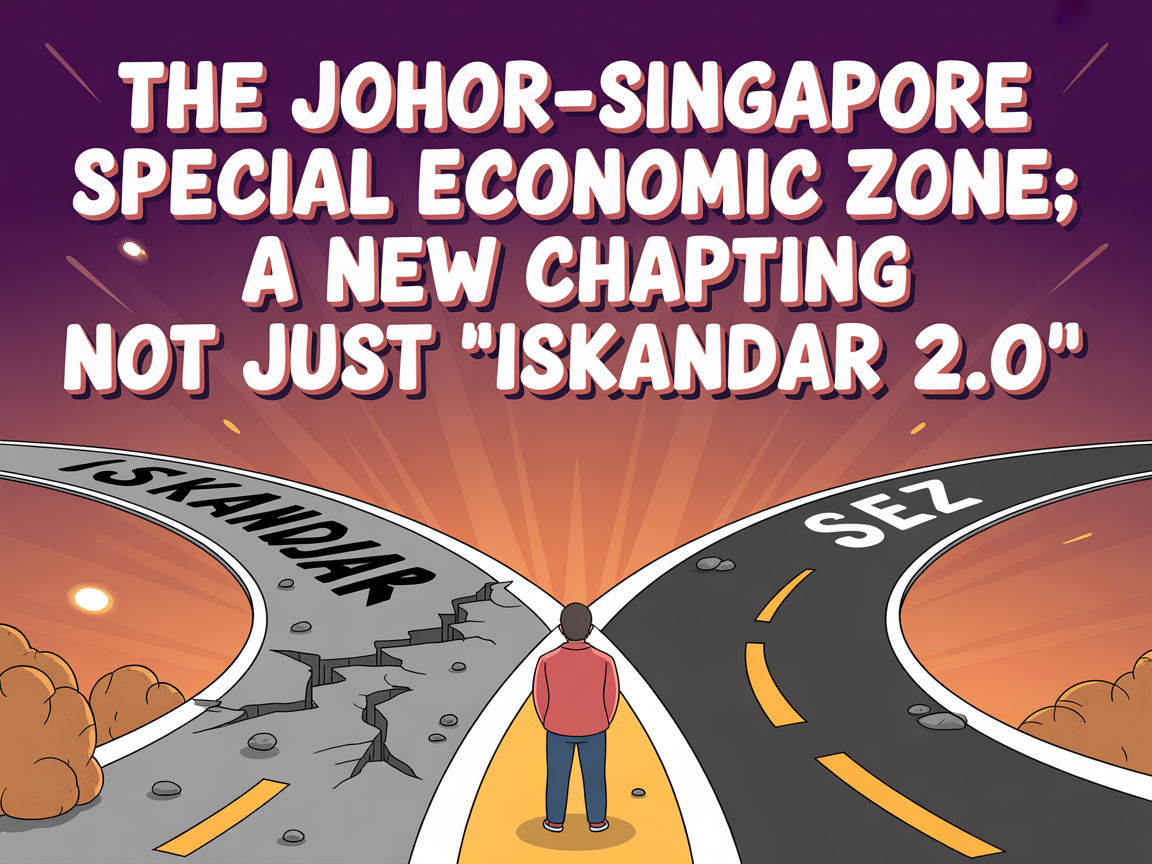
The Johor-Singapore Special Economic Zone: A New Chapter, Not Just “Iskandar 2.0”

Posted by Jayson Ang on April 26, 2026
| 0

TLDR

The Johor-Singapore Special Economic Zone (JS-SEZ), launched in January 2025, is a bilateral effort aimed at sustainable economic growth in southern Johor, focusing on manufacturing, logistics, digital economy, and green energy. Unlike the early 2000s Iskandar project, JS-SEZ benefits from strong Singapore-Malaysia collaboration, streamlined regulations, and significant incentives like low corporate tax rates. Key improvements include the upcoming RTS Link for better cross-border connectivity and cautious property development to avoid oversupply issues. The initiative prioritizes attracting industrial and service investments over speculative property buying. Despite these strengths, risks such as currency volatility and potential political changes remain. Investors should consider these factors carefully but can be cautiously optimistic about JS-SEZ’s prospects compared to previous efforts.

For many Singaporeans, the mention of property investment in Johor still evokes skepticism, often accompanied by references to the “Iskandar situation” of the early 2000s. During that period, Iskandar Malaysia, despite similar ambitious promises, ultimately became a cautionary tale of overzealous real estate speculation. Naturally, a common question now is: “What’s different this time with the Johor-Singapore Special Economic Zone (JS-SEZ)?”

Understanding the Johor-Singapore Special Economic Zone (JS-SEZ):

Announced in January 2025, the JS-SEZ is a bilateral economic initiative between Malaysia and Singapore. Its objective is to create an “economic corridor” in southern Johor, encompassing districts like Johor Bahru, Iskandar Puteri, and Pasir Gudang. The zone aims to boost key sectors in both countries, including manufacturing, logistics, the digital economy, and green energy.

A key differentiator from the 2000s Iskandar initiative is the emphasis on stronger collaboration between the two nations. This is exemplified by the establishment of a joint project office involving Singapore’s Ministry of Trade and Industry and Malaysia’s Economic Ministry, designed to ensure smoother regulatory processes for investors. The JS-SEZ also includes dedicated incentive packages, such as corporate tax rates as low as 5% in the relevant regions. Notably, the problematic Forest City project is slated for repurposing into a Special Financial Zone, implying a distinct regulatory framework to attract international businesses with streamlined processes for foreign professionals.

Fundamentally, the JS-SEZ represents a strategic refocus on sustainable, long-term economic development for the region, explicitly aiming to prevent the unchecked property speculation that characterized the earlier Iskandar phase.

Why This Time Is Different:

  1. Bilateral Endeavor, Not a Solo Project: Unlike Iskandar Malaysia, which was largely a Malaysian-driven initiative with limited formal Singaporean involvement, the JS-SEZ is a full-fledged bilateral undertaking with active co-steering by both governments. This provides Singaporean investors with greater assurance regarding policy alignment, infrastructure coordination, and long-term political will, addressing a key weakness of the Iskandar years. Information and updates are disseminated by both governments, ensuring transparency and equitable access for investors. Furthermore, the JS-SEZ includes a one-stop center (IMFC-J) in Johor and commits to smoother investment processing, with direct involvement from Singaporean agencies, aiming to mitigate the bureaucratic frustrations experienced in the past.
  2. Improved Connectivity with the RTS Link: A crucial element missing from the previous Iskandar initiative was a tangible, high-capacity transport link. The Johor Bahru-Singapore RTS Link is now scheduled to commence operations by end-2026, with a capacity to transport 10,000 passengers per hour per direction. This firm infrastructure timeline fundamentally alters the connectivity landscape, providing a concrete and significant improvement for cross-border movement.
  3. Lessons Learned from Previous Supply Issues: Iskandar Malaysia became notorious for its oversupply of properties, leading to “ghost towns” and empty condominiums, particularly exemplified by Forest City, which was built on the premise of substantial, yet unrealized, foreign demand.
    Today, Johor developers exhibit greater caution. Data from the National Property Information Centre (Napic) shows a significant 16% reduction in overhang properties in Johor Bahru, from 16,799 units in 2022 to 14,063 in 2024. This indicates quicker market absorption and enhanced developer discipline. The JS-SEZ’s incentives are strategically focused on attracting genuine industrial and services investments first, shifting emphasis away from speculative property plays. The property market in Johor has matured over the past two decades, and the current targeted demand—cross-border workers and logistics firms—is more grounded in economic realities. While market unpredictability persists, there’s an observable collective learning from past mistakes.

Conclusion: A Reboot with Stronger Foundations:

It is inaccurate to simply label the JS-SEZ as “Iskandar 2.0.” It represents a comprehensive reboot, characterized by superior bilateral coordination, tangible transport infrastructure, and a focus on targeted economic activity. While investors should always exercise caution, the underlying foundations of the JS-SEZ appear significantly stronger, making it more likely to translate promises into performance.

Enduring Risks: Currency and Political Volatility:

Despite stronger bilateral coordination, investors must remain cognizant of inherent macro risks. The Malaysian ringgit’s volatility against the Singapore dollar means that any paper gains could be eroded by adverse exchange rate movements. Furthermore, while the JS-SEZ reflects a shared political will at present, future domestic policy shifts in either country (particularly Malaysia) could still impact long-term execution. Previous instances where changes in Malaysian administrations affected the momentum of the Iskandar initiative serve as a reminder of these political risks. Therefore, while the JS-SEZ framework is robust, these broader macroeconomic and political factors should be integrated into any long-term investment outlook.

Should You Buy, Sell or Wait?

If you’re reading this, you must be trying to figure out the best course of action right now: is it the right time to buy or sell?

It’s difficult to give an exact answer since everyone’s situation is unique and what works for one person may not necessarily work for you.

I can bring you a wealth of on-the-ground experience and a data-driven approach to provide clarity and direction. From beginners to experienced investors, our top-down, objective approach will help you on your real estate journey.

I can help you by:

  1. Offering Strategic Real Estate Advice – I can help create a comprehensive plan to guide you through your property journey.
  2. Connecting Your Home with the Perfect Buyers – Through stunning visuals, an effective communication strategy, and an in-depth knowledge of the market, we’ll ensure your home is presented in the best possible way to fulfill your goals.

You May Also Like …


What Difference in One Year After the ABSD Hike in April 2023?
All Blog Posts Buying Tips Opinion Reports

What Difference in One Year After the ABSD Hike in April 2023?

TLDR The recent hike in ABSD rates, especially the increase from 30% to 60% for foreign buyers, has dramatically affected...
Read More
ANALYSIS: Unveiling the HDB Towns with the Steepest and Lowest Price Surges!
All Buying Tips

ANALYSIS: Unveiling the HDB Towns with the Steepest and Lowest Price Surges!

TLDR The real estate market for HDB flats in Singapore has witnessed significant growth, with prices reaching new highs. The...
Read More
The Secret Strategies of Singapore’s Property Tycoons: Lessons You Can Learn
Mandarin Top 5

The Secret Strategies of Singapore’s Property Tycoons: Lessons You Can Learn

The Singapore property market has always been a hot topic for both locals and foreign investors. With its stable economy,...
Read More
Top 5 Nature Walks in Singapore for Hikers
Mandarin Top 5

Top 5 Nature Walks in Singapore for Hikers

Singapore, a bustling city-state known for its impressive skyline and modern architecture, is also home to a plethora of natural...
Read More
5 Key Insights to Take Away from the Latest 2022 Cooling Measures
All Blog Posts Buying Tips

5 Key Insights to Take Away from the Latest 2022 Cooling Measures

TLDR Affordability of HDB Market: Government is focused on ensuring affordable public housing and may increase supply if needed. Long-term...
Read More
Should You Keep Your Resale HDB Flat When Buying a Private Property? 5 Key Factors to Consider
All Blog Posts Buying Tips Opinion Selling Tips

Should You Keep Your Resale HDB Flat When Buying a Private Property? 5 Key Factors to Consider

TLDR In Singapore, owning both an HDB flat and a private property has become complicated due to factors like Additional...
Read More
Top 5 : Advantages of Owning a Luxury Condominium in Singapore for Long-Term Investment
Mandarin Top 5

Top 5 : Advantages of Owning a Luxury Condominium in Singapore for Long-Term Investment

Singapore, a thriving global city-state, has become an attractive destination for real estate investors. Among the various property types available,...
Read More
My Dad’s Agent Utilised Misleading Information to Coerce Him into Selling His HDB” – 4 Pushy Sales Techniques You Should Be Aware Of
All Buying Tips Opinion Selling Tips

My Dad’s Agent Utilised Misleading Information to Coerce Him into Selling His HDB” – 4 Pushy Sales Techniques You Should Be Aware Of

TLDR While Singapore’s real estate sector is more regulated, some agents still use high-pressure tactics that make buyers uncomfortable. Common...
Read More
Singapore’s Population Hits 6.11M — What It Means for Housing Demand
All Blog Posts Opinion

Singapore’s Population Hits 6.11M — What It Means for Housing Demand

TLDR Singapore’s population has reached a record 6.11 million, driven mainly by non-residents rather than local births. With fertility at...
Read More
Top 5 Vegetarian Restaurants in Singapore
Mandarin Top 5

Top 5 Vegetarian Restaurants in Singapore

Singapore, a melting pot of cultures and cuisines, offers a diverse range of dining options for food enthusiasts. For vegetarians,...
Read More
Top 5 Reasons to Invest in Commercial Property in Singapore – Expert Insights!
Mandarin Top 5

Top 5 Reasons to Invest in Commercial Property in Singapore – Expert Insights!

Singapore, a thriving business hub in Southeast Asia, offers a robust real estate market with diverse investment opportunities. While residential...
Read More
Say Goodbye to “Sell One, Buy Two” Approach in 2024
All Buying Tips Opinion

Say Goodbye to “Sell One, Buy Two” Approach in 2024

TLDR Summary: The "Sell One, Buy Two" real estate tactic, popularized in 2016-2017, involves selling a property and buying two...
Read More
What Is Cash Over Valuation in HDB (COV)
All Buying Tips

What Is Cash Over Valuation in HDB (COV)

TLDR Cash Over Valuation (COV) in HDB resale flats occurs when the purchase price exceeds HDB's valuation. COV cannot be...
Read More
What Impact Will Decreasing US Interest Rates Have on Homeowners in Singapore?
All Buying Tips Opinion Selling Tips

What Impact Will Decreasing US Interest Rates Have on Homeowners in Singapore?

TLDR The Fed’s recent 0.5% rate cut is likely to lower Singapore’s SORA-based home loan rates, benefiting those with bank...
Read More
Top 5 Reasons Why Singapore’s Property Market Is A Haven For High Net Worth Investors
Mandarin Top 5

Top 5 Reasons Why Singapore’s Property Market Is A Haven For High Net Worth Investors

Singapore's property market has long been a magnet for high net worth investors, both local and international. The city-state's strategic...
Read More
Singapore Decoupling Guide
All Blog Posts Buying Tips

Singapore Decoupling Guide

TLDR Decoupling in Singapore's real estate refers to the process of separating property ownership to avoid Additional Buyer's Stamp Duty...
Read More
The Top 5 Impact Of Singapore’s Ageing Population On The Property Market And Investment Opportunities
Mandarin Top 5

The Top 5 Impact Of Singapore’s Ageing Population On The Property Market And Investment Opportunities

Singapore's ageing population is having a significant impact on the property market and investment opportunities. The top five effects include:...
Read More
First-Time Homeownership After 40 in Singapore: Navigating Unique Risks
All Buying Tips Opinion

First-Time Homeownership After 40 in Singapore: Navigating Unique Risks

TLDR Older first-time homebuyers face unique challenges including lease decay risks, stricter loan-to-value (LTV) limits, and shorter loan tenures leading...
Read More
Reasons Why En-Bloc Sales Are Expected to Remain Slow in 2025
All Opinion

Reasons Why En-Bloc Sales Are Expected to Remain Slow in 2025

TLDR From 2014 to 2024, the en-bloc market has faced challenges due to fluctuating cooling measures and a shift from...
Read More
6 Misleading Claims Property Agents Often Make That Savvy Buyers Are Aware Of
All Buying Tips Opinion

6 Misleading Claims Property Agents Often Make That Savvy Buyers Are Aware Of

TLDR Real estate agents can sometimes use deceptive tactics to push sales. Be cautious of claims about other interested buyers,...
Read More
1 26 27 28 29 30 35

Compare Listings