Fraud Blocker
Your search results

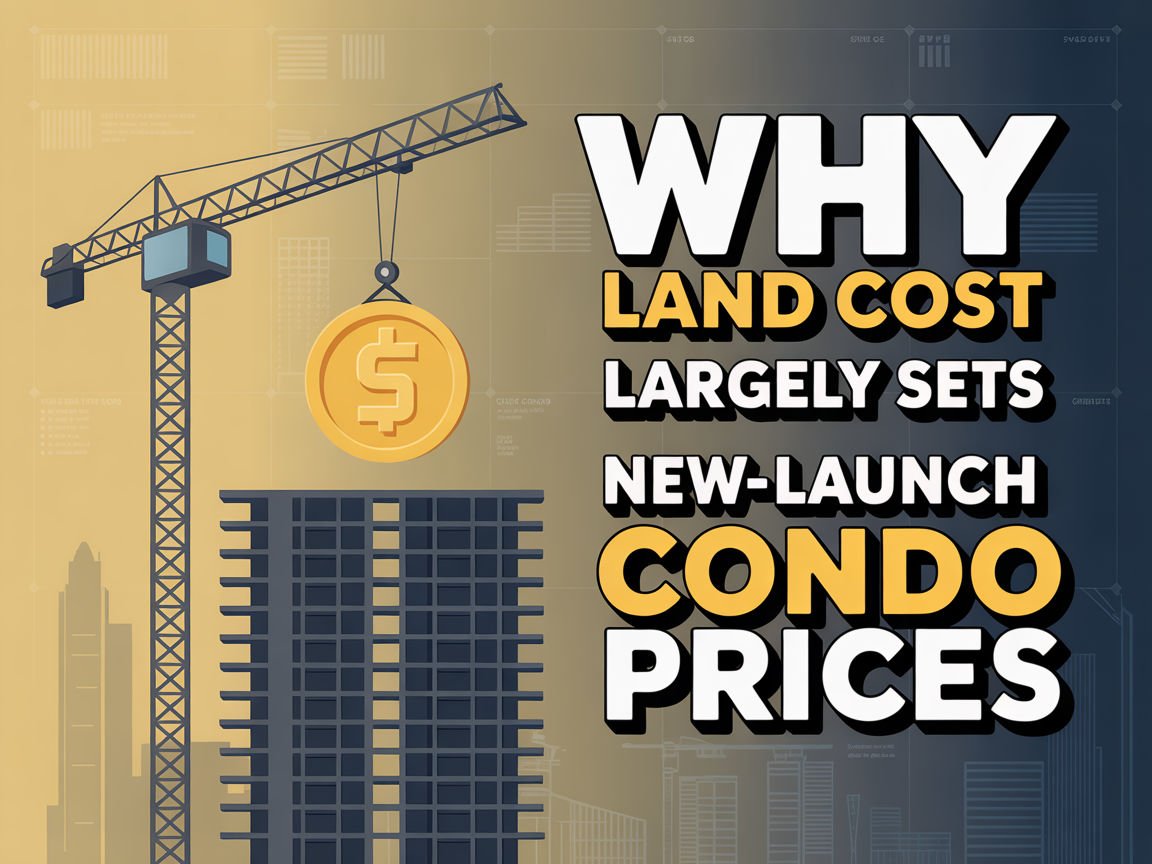
Why Land Cost Largely Sets New‑Launch Condo Prices (And How To Use It To Judge A Fair Launch)

Posted by Jayson Ang on November 2, 2026
0 Comments

TLDR

New‑launch condo prices in Singapore are primarily anchored by land cost, which typically accounts for about 70% of the eventual selling price. Developers add roughly 20% for construction, financing, and contingencies, plus another 10–15% for profit and marketing. This arithmetic sets a breakeven and expected launch band, though premiums may arise from factors like integrated MRT/retail links, project scale, or site complexities. For example, AMO Residence and Canberra Crescent launches closely matched land‑based estimates, while projects like Sceneca and Terra Hill exceeded them due to harmonisation rules or engineering challenges. Buyers can use land bid prices (psf ppr) as a compass: if launch prices fall within the expected band, they’re broadly defensible; if far above, one should question whether location or market hype justifies the premium. Ultimately, land economics provide a practical framework to judge whether a new launch is fairly priced.

Location matters, yes — but the single biggest driver of a developer’s launch price is almost always the land cost. When a developer pays heavily for a plot (via GLS or an en‑bloc), that winning bid creates a hard floor. From there, construction, finance, marketing and profit are stacked on top. Below I explain the basic arithmetic developers use, the common caveats, and how you can use land prices to assess whether a launch looks fair.

A note about launch timing The framework here applies best at the initial launch phase (roughly the first 12 months). Developers tend to raise prices over time if demand is strong, so later rounds usually cost more. If you want a sense of the starting price range, land cost plus a standard markup is the useful guide.

How land cost feeds into pricing Treat land cost as the baseline. When a developer wins a land bid, that ppr (price per plot ratio) or psf figure anchors the minimum they must recover. After that they add:

  • Construction and site works
  • Financing costs
  • Marketing and sales commissions
  • Contingencies and profit margin

Because GLS and en‑bloc bids are typically expressed as psf (ppr), those numbers translate directly into the per‑square‑foot economics of the finished condos. A very high land bid effectively hard‑wires a high breakeven psf.

A simple industry shortcut A commonly used rule of thumb is:

  • Roughly 70% of the eventual selling price reflects land cost (including land‑related levies and fees).
  • The remaining 30% is split between construction/overheads (20%) and developer margin/marketing/commissions (10%–15%).

So, for a plot bought at, say, $1,388 psf ppr, adding ~20% for hard costs gives you a breakeven around $1,666 psf. Add the developer’s margin and marketing (another ~20% on top of breakeven in many seller‑friendly markets) and you get expected launch pricing in the high $1,9xx to low $2,1xx psf range — assuming market conditions allow that margin.

Why it’s not exact Several legitimate reasons push final prices above or below this rule‑of‑thumb:

  • Project scale: mega‑developments spread fixed costs (show flats, marketing) across thousands of units, lowering per‑unit overheads. Small boutique projects have higher per‑unit overheads.
  • Market cycle: in a sellers’ market developers will target fuller margins; in weak markets margins can compress.
  • Site complexity: unusual groundworks (elevations, retaining walls, flood mitigation) or costly infrastructure approvals can add materially to development costs.
  • Policy changes: tightening rules, levy increases or GFA (gross floor area) harmonisation can raise effective psf or reduce saleable area — shifting the maths.
  • Integrated developments: projects with MRT, retail or town‑centre integration often command a premium beyond the simple formula.

Real examples that show the mechanics

  • AMO Residence (Ang Mo Kio Ave 1 GLS) — site awarded at roughly $1,118 psf ppr. Using the +70/+20 approach pointed to launch pricing around $1,900–$2,100 psf. When AMO launched, initial pricing began close to that band and average early sales sat near $2,100 psf — nearly matching the simple model.
  • Canberra Crescent Residences — plot awarded at ~ $721 psf ppr. The formula implied a breakeven of ~$1,200+ psf and a launch band in the high $1,7xx–$2,0xx psf area. Early launches in that market indeed clustered around ~$1,974 psf.
  • Sceneca Residence and Sengkang Grand Residences illustrate how post‑GFA harmonisation and project integration can push launch prices above basic predictions. Sceneca’s site had a lower ppr, but the removal of certain saleable areas after harmonisation raised the effective psf; Sengkang Grand’s integrated MRT/retail link commanded a location premium that lifted pricing well beyond a vanilla ppr‑based estimate.
  • Terra Hill is a cautionary example where site‑specific engineering (elevation, slope stabilisation) added substantial cost. Land bought at about $1,355 psf ppr suggested one breakeven band, but required extra civil works that pushed expected launch prices higher than simple models predicted.

Harmonisation and harmonics: saleable area matters GFA harmonisation (removing aircon ledges and other non‑livable areas from saleable floor area) reduces the saleable sqft the developer can sell. If a site was bought before harmonisation, the developer may need to raise the psf to recoup the same revenue, which pushes launch pricing upward. This is why identical ppr figures can result in different launch psf outcomes depending on when and how the land was acquired.

Practical rules buyers can use

  1. Find the land ppr (or en‑bloc psf) for the site. This is the baseline.
  2. Add ~20% to get a rough breakeven (construction, financing, contingency).
  3. Add another ~20% to estimate a typical developer launch price in a seller’s market.
    If the resulting band is, for example, $1,900–$2,100 psf and the developer’s launch prices are within that range, the pricing is broadly explainable. If they’re far above it, ask why — location premium? integrated links? limited competition? Or is the market simply overheated?

When the formula breaks down

  • A developer may price above the model because the immediate local norm is already high; buyers often expect prices near existing comparable projects, and developers can exploit that.
  • Conversely, if a developer paid an unusually low land price, they might still launch at prevailing market rates to maximise margin — which means lower land cost doesn’t guarantee cheaper launches for buyers.
  • Large integrated or prestige sites (waterfront, direct MRT access) frequently command a premium over the +70/+20 estimate.

How to judge whether a launch is a “good deal”

  • Use the land ppr as your compass: it shows the developer’s minimum and room for margin.
  • Check for project‑specific upward drivers: integration with transport/retail, unique views, or scarcity of alternatives nearby. Those justify premiums above baseline.
  • Compare with nearby recent launches and en‑bloc prices: if the new launch sits well above both land‑based estimates and local norms, be cautious; conversely, pricing comfortably within the expected band can be defensible for early buyers.

Final thoughts The land price is the structural anchor behind most new‑launch pricing. The +70% (land) +20% (hard costs) +20% (margin/marketing) heuristic won’t give you an exact psf, but it tells you where the floor and reasonable launch range lie. Adjust the numbers up for project complexity, integration, and prevailing market appetite; adjust down for scale benefits or weak demand.

If you want, I can run the math for a specific GLS award or en‑bloc price and show the breakeven and plausible launch band. That’s a practical way to see whether a new project’s asking psf is supported by the land economics — or whether you’re just paying landscaping and branding.

Should You Buy, Sell or Wait?

If you’re reading this, you must be trying to figure out the best course of action right now: is it the right time to buy or sell?

It’s difficult to give an exact answer since everyone’s situation is unique and what works for one person may not necessarily work for you.

I can bring you a wealth of on-the-ground experience and a data-driven approach to provide clarity and direction. From beginners to experienced investors, our top-down, objective approach will help you on your real estate journey.

I can help you by:

  1. Offering Strategic Real Estate Advice – I can help create a comprehensive plan to guide you through your property journey.
  2. Connecting Your Home with the Perfect Buyers – Through stunning visuals, an effective communication strategy, and an in-depth knowledge of the market, we’ll ensure your home is presented in the best possible way to fulfill your goals.

You May Also Like …


Invest During the Bearish & Exit During the Bullish
All Blog Posts Opinion

Invest During the Bearish & Exit During the Bullish

TLDR A comprehensive overview of the real estate market trends, emphasizing the importance of strategic property analysis and investment decisions....
Read More

Top 5 Must-Try Foods in Singapore
Mandarin Top 5

Top 5 Must-Try Foods in Singapore

Top 5 Must-Try Foods in Singapore Singapore, a melting pot of cultures and cuisines, offers a diverse and tantalizing array...
Read More
The Top 5 Myths About Buying Property in Singapore – Debunked!
Mandarin Top 5

The Top 5 Myths About Buying Property in Singapore – Debunked!

The Top 5 Myths About Buying Property in Singapore – Debunked! Here are the top 5 myths about buying property...
Read More
Should You Splash Your Cash on a Condo Despite the Sky-High PSF?
All Buying Tips Opinion

Should You Splash Your Cash on a Condo Despite the Sky-High PSF?

TLDR The blog post discusses various aspects of investing in condos in Singapore, covering topics such as leasehold versus freehold...
Read More
Top 5 Singaporean Dishes to Try
Mandarin Top 5

Top 5 Singaporean Dishes to Try

Singapore, a melting pot of diverse cultures and flavors, is known for its rich culinary heritage. With influences from Chinese,...
Read More
Can You Make the Leap to a Condo Upgrade in 2024?
All Buying Tips Opinion

Can You Make the Leap to a Condo Upgrade in 2024?

As the Chinese New Year festivities wind down, folks are once again on the prowl for new homes, and understandably,...
Read More
Purchasing Older HDB Resale Flats: Key Considerations When the Flat Outlives You
All Buying Tips

Purchasing Older HDB Resale Flats: Key Considerations When the Flat Outlives You

TLDR HDB flats have a 99-year lease, and key housing schemes require the lease to cover the youngest owner until...
Read More
Singapore’s Housing Phenomenon: A Success Tale Calling for Tweaks – Insights from the Experts
All Opinion

Singapore’s Housing Phenomenon: A Success Tale Calling for Tweaks – Insights from the Experts

TLDR Singapore's housing system has been praised for its effectiveness in meeting citizens' homeownership desires. The public housing program by...
Read More
What You Need to Know About Residential En Bloc Sales in 2025
All Opinion

What You Need to Know About Residential En Bloc Sales in 2025

TLDR En bloc sales in Singapore involve selling entire buildings to developers for redevelopment, with most owners needing to agree....
Read More
Has Singapore’s Definition of “Prime” Shifted Now That Fringe Homes Hit $2,000 PSF?
All Buying Tips Opinion

Has Singapore’s Definition of “Prime” Shifted Now That Fringe Homes Hit $2,000 PSF?

TLDR Singapore’s definition of “prime” property is shifting as fringe homes in the Outside Central Region (OCR) now command prices...
Read More
HDB Market Outlook 2023
All Blog Posts

HDB Market Outlook 2023

TLDR: Understanding the HDB Market Outlook 2023 The HDB resale market showed resilience in 2022, with significant growth in sales...
Read More
The Advantages and Disadvantages of Purchasing an Auction Property in Singapore
All Blog Posts Buying Tips

The Advantages and Disadvantages of Purchasing an Auction Property in Singapore

TLDR When considering purchasing a property through auction in Singapore, remember that you can potentially get a great deal below...
Read More
Planning for Retirement: Considerations for Downsizing Your Property
All Blog Posts Buying Tips

Planning for Retirement: Considerations for Downsizing Your Property

TLDR Downsizing your home for retirement can bring financial security, closer family ties, and new adventures. Consider the benefits of...
Read More
Reasons I Might Still Spend $1 Million On A 50-Year-Old HDB—Despite Everyone Claiming It’s A Poor Investment
All Opinion

Reasons I Might Still Spend $1 Million On A 50-Year-Old HDB—Despite Everyone Claiming It’s A Poor Investment

TLDR Spending $1 million on a 50-year-old HDB flat in Singapore can be a rational choice for older buyers prioritizing...
Read More
How Will Singapore’s Development Influence The Real Estate Markets In Bedok, Changi, Pasir Ris, And Tampines : 2023
All Blog Posts Opinion

How Will Singapore’s Development Influence The Real Estate Markets In Bedok, Changi, Pasir Ris, And Tampines : 2023

TLDR You will find detailed insights into upcoming housing developments in the East of Singapore, specifically in areas like Bayshore,...
Read More
Dual-Key Condo: Analysing The Pros And Cons
All Buying Tips Opinion

Dual-Key Condo: Analysing The Pros And Cons

TLDR for "Dual-Key Condo: Analysing The Pros And Cons" When considering dual-key condo units, it's important to weigh the advantages...
Read More
Singapore’s Real Estate Market: The 5 Most Important Documents to Review Before Buying a Property
Mandarin Top 5

Singapore’s Real Estate Market: The 5 Most Important Documents to Review Before Buying a Property

Singapore's real estate market is highly regulated and can be complex for those unfamiliar with the process. As a prospective...
Read More
Top 5 Factors: Singapore Offer A Stable And Lucrative Investment Opportunity In Real Estate?
Mandarin Top 5

Top 5 Factors: Singapore Offer A Stable And Lucrative Investment Opportunity In Real Estate?

Singapore, a small yet economically powerful city-state, has long been recognized as one of the most attractive destinations for real...
Read More
How to Build a Property Empire in Singapore: Scaling Your Investments
Mandarin Top 5

How to Build a Property Empire in Singapore: Scaling Your Investments

Real estate investing is a popular way to build wealth and generate passive income. However, like any investment, it comes...
Read More
Top 5 Tourist Attractions in Singapore
Mandarin Top 5

Top 5 Tourist Attractions in Singapore

Top 5 Tourist Attractions in Singapore Singapore, a vibrant city-state located in Southeast Asia, is known for its diverse culture,...
Read More
1 … 6 7 8 9 10 … 37

Compare Listings